
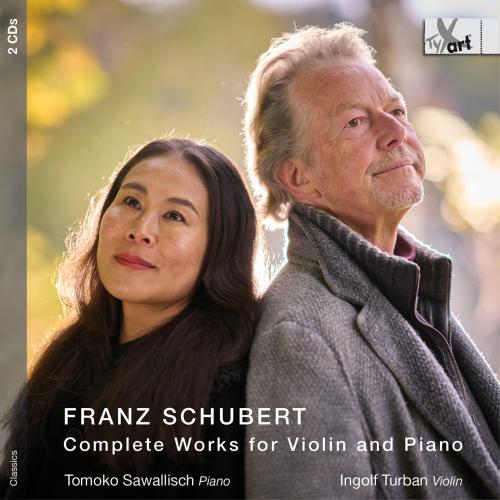
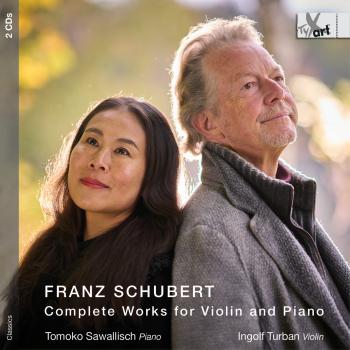
Complete Works for Violin and Piano Ingolf Turban & Tomoko Sawallisch
Album info
Album-Release:
2026
HRA-Release:
06.02.2026
Label: TYXArt
Genre: Classical
Subgenre: Instrumental
Artist: Ingolf Turban & Tomoko Sawallisch
Composer: Franz Schubert (1797-1828)
Album including Album cover
- Franz Schubert (1797 - 1828): Violin Sonata in D Major, Op. 137 No. 1, D. 384:
- 1 Schubert: I. Allegro molto 04:25
- 2 Schubert: II. Andante 04:02
- 3 Schubert: III. Allegro vivace 04:24
- Violin Sonata in A Minor, Op. 137 No. 2, D. 385:
- 4 Schubert: I. Allegro moderato 09:33
- 5 Schubert: II. Andante 06:28
- 6 Schubert: III. Menuetto: Allegro 02:16
- 7 Schubert: IV. Allegro 04:57
- Violin Sonata in G Minor, Op. 137 No. 3, D. 408:
- 8 Schubert: I. Allegro giusto 05:09
- 9 Schubert: II. Andante 05:44
- 10 Schubert: III. Menuetto 02:38
- 11 Schubert: IV. Allegro moderato 04:06
- Violin Sonata in A Major, Op. 162, D. 574 "Duo":
- 12 Schubert: I. Allegro moderato 08:34
- 13 Schubert: II. Scherzo: Presto 04:01
- 14 Schubert: III. Andantino 03:52
- 15 Schubert: IV. Allegro vivace 05:36
- Rondo in B Minor, Op. 70, D. 895 "Rondo brillant":
- 16 Schubert: Andante 02:48
- 17 Schubert: Allegro 11:41
- Fantasie in C Major, Op. 159, D. 934:
- 18 Schubert: Andante molto 03:20
- 19 Schubert: Allegretto 05:40
- 20 Schubert: Andantino 09:49
- 21 Schubert: Tempo I 01:08
- 22 Schubert: Allegro vivace - Allegretto - Presto 04:47
Info for Complete Works for Violin and Piano
Franz Schubert, who hardly ever owned a violin of his own, created music of wonderful inwardness for this instrument. Not a virtuoso in the conventional sense, he was a master of emotional sound speech. Like his piano works, his pieces for violin and piano also open up that sphere of the "there" in which the earthly merges into transcendence. In their dialogue, the opposing worlds of the violin – the "torn tone" – and the piano – the "bound melody" – meet to form a lyrical unity that does not "represent" anything, but simply "is".
Between 1816 and 1817 he wrote four sonatas in which Schubert took his cue from Mozart and yet went his own way. Behind the cheerful façade of the so-called "sonatinas" there is often a deep seriousness. The young composer transforms the classical form into a space of floating harmony in which melody takes the place of motivic work – music as sensation, not as construction. In the Sonata A major of 1817, this principle achieves pure lyricism: heaven and earth touch each other without ever uniting.
Ten years later, two late masterpieces followed: the Rondeau brillant in B minor (1826) and the Fantasy in C major (1827). Both are dedicated to the young violinist Josef Slawjk, whose virtuosity inspires Schubert to the intellectual penetration of the brilliant. A mysterious abyss lurks behind the glittering surface of the Rondeau – Paganini's "demonic spirit" appears transfigured as an angel's voice. Finally, in the Fantasy, Schubert transcends all boundaries of form. The work, which weaves the song "Sei mir gegrüsst" (Greetings to me) into its structure, becomes a musical symbol of farewell and redemption. Virtuoso gestures are transformed into existential expression; the song of love resonates as a distant memory – between dream, death and transcendence.
This music is not a concert piece, but a poetic revelation: Schubert's "Music of the Spheres", in which the "here" and the "there" become one for a moment.
Ingolf Turban, violin
Tomoko Sawallisch, piano
Please Note: We offer this album in its native sampling rate of 48kHz, 24-bit. The provided 96kHz version was up-sampled and offers no audible value!
Ingolf Turban
was born in Munich in 1964 and was admitted to Gerhart Hetzel’s violin class there at the age of 12. He attended masterclasses with Jens Ellermann and Dorothy DeLay in the USA.
In 1985, Ingolf Turban became First Concertmaster of the Munich Philharmonic, and in 1986 he made his solo debut under the baton of Sergiu Celibidache in Munich. In 1988, he left the orchestra and dedicated more time to his solo career. In 1991, he made his debut at La Scala, Milan, and his USA debut in Washington. He appeared as soloist in the Berlin Philharmonie and the Munich Philharmonie, the Kennedy Center in Washington, New York’s Avery Fisher Hall, the Tonhalle in Zürich, the Golden Hall of the Musikverein in Vienna and La Scala in Milan with conductors such as Sergiu Celibidache, Charles Dutoit, Lorin Maazel, Zubin Mehta, Yehudi Menuhin, Jun Märkl, Yutaka Sado, Franz Welser-Möst, Andris Nelsons and Marcello Viotti.
Tomoko Sawallisch
Since her German debut with Brahms’ First Piano Concerto, she has performed as a soloist in Europe and Japan. She is increasingly enthusiastic about chamber music, for example in collaboration with Stephan Koncz, Ingolf Turban and Markus Wolf.
She was selected as a Steinway Artist by Steinway & Sons in 2015 and thus belongs to another exclusive circle of internationally recognised pianists and artistic personalities.
Tomoko Sawallisch lives near Munich. In addition to her concert and teaching activities, she is a member of the advisory board of the Prof. Wolfgang Sawallisch Foundation and its representative in Japan. She is a member of the jury committee of the Osaka International Music Competition.
The former master student of Gerhard Oppitz, who received her first piano lessons from her mother at the age of four, has won numerous prizes and awards in her home country of Japan.
This album contains no booklet.