


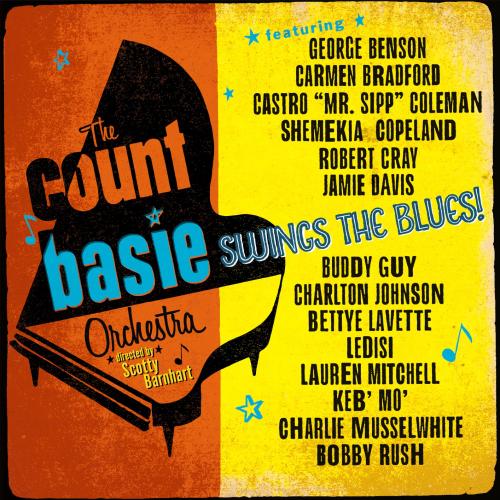
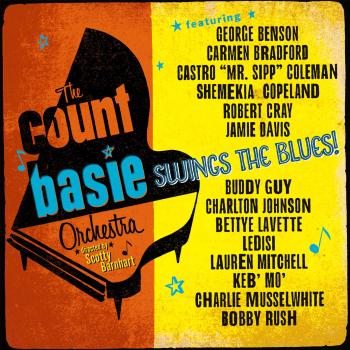
Basie Swings The Blues The Count Basie Orchestra
Album info
Album-Release:
2023
HRA-Release:
05.03.2026
Album including Album cover
- 1 Let's Have A Good Time 04:07
- 2 Boogie In The Dark 03:55
- 3 I'm A Woman 04:59
- 4 Down Home Blues 04:37
- 5 The Patton Basie Shuffle 04:32
- 6 Dirty Mississippi Blues 03:59
- 7 Stormy Monday 03:16
- 8 The Midnight Hour 03:34
- 9 Evil Gal Blues 03:21
- 10 Look What You've Done 02:51
- 11 Just For A Thrill 02:50
- 12 Rock Candy 05:26
Info for Basie Swings The Blues
Basie Swings the Blues is the latest recording by the legendary Count Basie Orchestra under the direction of Scotty Barnhart, and captures the raw emotion, infectious rhythm, and profound storytelling that are hallmarks of both jazz and blues. Released September 15th, 2023 via Candid Records, the album fuses Basie signature style of sophisticated swing with the raw and soulful talents of a cross section of blues legends and current stars, these revered artists take listeners on a captivating journey through the heart and soul of American music and showcase a shared musical language that still powerfully impacts listeners across the world. This extraordinary recording celebrates the deep-rooted connection between jazz and blues and illuminates shared roots and reciprocal influence, reminding us that the boundaries between these genres are fluid and the essence of both lies in the heartfelt expression of the human experience.
Produced by Barnhart along with Grammy-winning producer John Burk (Ray Charles Genius Love Company), and Grammy-winning drummer/producer Steve Jordan (The Rolling Stones), the album brings together Buddy Guy, Bobby Rush, Keb’ Mo’, Shemekia Copeland, Robert Cray, Charlie Musselwhite, Betty LaVette, Ledisi, George Benson, and others to bring the blues and swing back together for a set that jumps and jives with an energy not heard since Louis Jordan and T-Bone Walker lit up stages in the ’40s and ’50s.
"A superstar in R&B circles, Ledisi delivers a sophisticated version of “Evil Gal Blues,” trading her vocals with Lawrence’s flowing tenor sax response, picking up intensity as the tune progresses. A two-time Grammy nominee as the Basie Orchestra’s vocalist, baritone powerhouse Jamie Davis takes command on “Look What You’ve Done” then gives way to “Just for a Thrill,” which features Carmen Bradford, who fronted the band in the ‘90s before going on to an award-winning career of her own. The disc comes to a majesty close with dazzling fret work of George Benson on the rapid-fire instrumental, “Rock Candy.” (bluesblastmagazine.com)
"Each of the singers is excellent and the music is mostly classic 1950s-style blues. While there are occasional short solos (mostly from tenor-saxophonist Doug Lawrence), the Basie band is primarily in a supportive and often somewhat anonymous role. The one exception is the closing number and lone instrumental, “Rock Candy,” which has the orchestra being joined by organist Bobby Floyd and guitarist George Benson for a rollicking performance. While one wishes that the Count Basie Orchestra was featured much more on these blues numbers, the excellence of the guests and the consistently joyful feelings generated by the music serves as compensation." (Scott Yanow, AMG)
The Count Basie Orchestra
Scotty Barnhart, trumpet, musical director
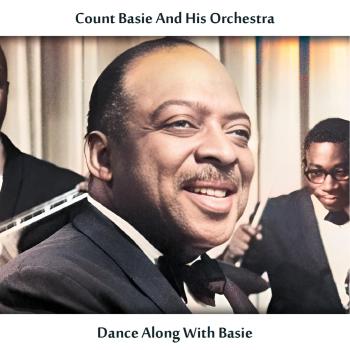

Count Basie
Born in Red Bank, New Jersey, in 1904, William "Count" Basie was not always the fabled "Count". He began his career as Bill Basie, an itinerant pianist who made his living pounding keys in theaters featuring silent movies and touring on the Theater Owners Booking Agency (TOBA) circuit, a hopscotch run of independent performance venues, in black communities stretching from East to West, North and South.
TOBA was also known as Tough On Black Artists, or less affectionately Tough On Black you-know-whats. In 1927, Basie, then touring with Gonzelle White and the Big Jazz Jamboree, found himself "high and dry" in Kansas City, Missouri. It was unlikely that Basie had followed Horace Greeley's actually John B.L. Soule's entreaty to "Go West young man" and his destiny was certainly not manifest.
As Basie recounted in his autobiography, Good Morning Blues, "I don't remember what my plans were at the time, but in the meantime I got sick and had to go to the hospital."
Nevertheless, for a musician of Basie's inclinations, Kansas City was not a bad place to be stranded. In the 1920's and 30's, Kansas City was headquarters for the territory bands that played the mid and southwest. KC was also a veritable cauldron for the heady mixture of blues principles, ineffably swinging rhythms and brilliant instrumentalists that coalesced into one of the signature sounds of American music, both popular in its appeal and substantial in its musical import.
Basie quickly fell in with the best of the territory bands, including Walter Page's Blue Devils and Benny Moten's Kansas City Orchestra. By 1935, Basie's destiny was becoming manifest. He had formulated and was leading the band that epitomized Kansas City Swing, the Count Basie Orchestra. Along with the bands of Fletcher Henderson, Duke Ellington and Benny Goodman, Basie's orchestra would define the big band era.
While the media of the time crowned Benny Goodman the "King of Swing", the real King of Swinging was undoubtedly The Count. Basie's achievements, however, would transcend the Swing Era as such. The Basie orchestra evolved into one of the most venerable and viable enterprises in American music, as meaningful in its legacy and continuing productivity as any musical organization of the 20th, and now, 21st century.
Interestingly, the critical consensus charaterizes the Basie lineage in Biblical terms, as the Old and New Testament bands. The Old Testament band's style has been summed as a combination of democratically developed, or head, riff-driven arrangements, dripping with blues essence and relaxed, but relentless, swing that showcased a who's who of very distinctive instrumentalists and vocalists: Lester Young, Hershel Evans, Harry Edison, Buck Clayton, Dicky Wells, Jo Jones, Freddie Green and Jimmy Rushing among others.
In the early 1950's, The "New Testament" Count Basie Orchestra rose Phoenix-like from the ashes of the Big Band era. For the last fifty plus years, the Count Basie Orchestra has been an arranger's palette. Thad Jones, Ernie Wilkins, Neal Hefti, Sammy Nestico, and Frank Foster, to name a few of the more prominent Basie's penmen, have added volumes to the Basie Library. Through them, the Basie repertoire has continued to broaden harmonically and rhythmically, making it more than hospitable to the talents of successive generations of musicians. As Basie allowed for certain measure of change and for a variety of voices to emerge on the platform he created, his remained the ultimate sensibility.
Since Basie's passing in 1984, Thad Jones, Frank Foster, Grover Mitchell, Bill Hughes and now Dennis Mackrel have led the Count Basie Orchestra and maintained it as one of the elite performing organizations in Jazz.
Current members include musicians hired by Basie himself: John Williams (joined in 1970), Dennis Mackrel (joined in 1983), Carmen Bradford (joined in 1983), Clarence Banks (joined in 1984), as well as Mike Williams (1987, formerly w/Glenn Miller, NTSU 1 O'Clock), Doug Miller (1989, formerly w/Lionel Hampton), Scotty Barnhart (1992) and members who have joined in the last 15 years: David Keim (formerly w/Stan Kenton), Alvin Walker, Will Matthews, Marshall McDonald (formerly w/Lionel Hampton, Paquito D'Rivera's United Nations Jazz Orchestra), Doug Lawrence (formerly w/Benny Goodman, Buck Clayton), Cleave Guyton (formerly w/Lionel Hampton, Duke Ellington Orchestra), Freddie Hendrix (Illinois Jacquet, Charles Tolliver) and our newest members: Mark Williams (Howard University), Bruce Harris, Bobby Floyd and Marcus McLaurine (formerly w/Clark Terry)
This album contains no booklet.