


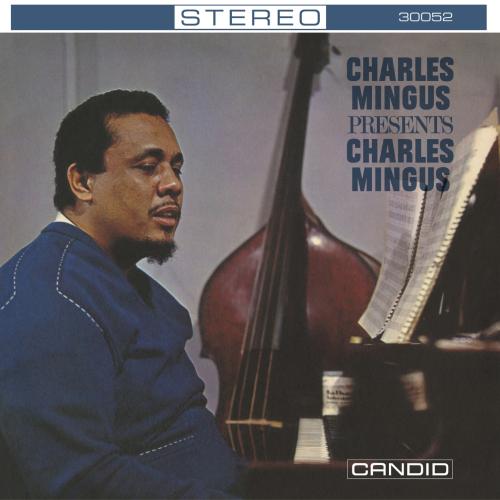
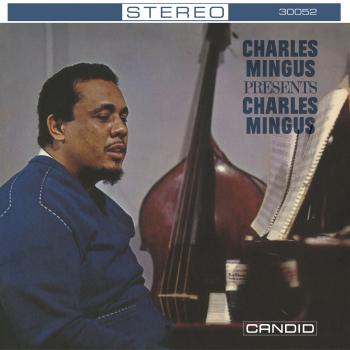
Charles Mingus Presents Charles Mingus (Remastered) Charles Mingus
Album info
Album-Release:
2022
HRA-Release:
05.03.2026
Album including Album cover
- 1 Folk Forms, No. 1 (Remastered) 12:58
- 2 Original Faubus Fables (Remastered) 09:13
- 3 What Love (Remastered) 15:18
- 4 All The Things You Could Be By Now If Sigmund Freud's Wife Was Your Mother (Remastered) 08:32
Info for Charles Mingus Presents Charles Mingus (Remastered)
Charles Mingus and his combo here, referred to by Mingus as The Jazz Workshop, had been in residence at the Showplace on W. 4th St. in Greenwich Village for nearly a year when they entered the studio to record what became the album Charles Mingus Presents Charles Mingus in October of 1961.
Saxophone and bass clarinet Eric Dolphy, trumpeter Ted Curson, and drummer Dannie Richmond had been performing the material on this album for weeks.
Mingus decided to set a mood that might resemble a night at the club, in hopes to capture the fierceness the musicians had been exploring on stage. "I finally realized that a lot of jazz records don"t make it because the guys almost unsoundly cage their approach in a studio from what they do every night"? Mingus said. "I finally wanted to make an album the way we are on the job"?
To recreate this atmosphere, Mingus introduces the songs as if he were speaking to the audience, giving off the illusion of a live album. The charade paid off.
Produced by Candid co-founder, famed music critic and social activist, Nat Hentoff, the album accomplishes what the best of Mingus"s work accomplishes; the perfect tension between jazz played as an ensemble and jazz played as totally free.
"Charles Mingus has a fascinating way of offering music that is grounded in tradition while remaining startlingly original. The freshness of a disc like Charles Mingus Presents Charles Mingus, has the effect of rendering much of what passes for jazz as tedious. The band is small for Mingus, and includes Eric Dolphy on alto saxophone and bass clarinet, Ted Curson on trumpet, and Dannie Richmond on drums. It would be one of Dolphy and Curson's last recording dates with the artist, and they seem determined to go all out for it. The leader's bassline kicks off "Folk Forms No. 1," followed by Dolphy outlining the melody, and then joined by Curson. A simple riff develops into a lively New Orleans funeral march that's developed for 12 minutes. "Original Faubus Fables" is serious in intent -- a political attack on segregation governor Faubus -- but Mingus and Richmond's singing is difficult to listen to with a straight face. Still, this doesn't distract from the wonderful music. Again and again, the elasticity of the sound is fascinating, at once spacious with the bass and drums balanced against the brass and then noisy, with the horns wailing and crying. The last two pieces, "What Love?" and the outrageously titled "All the Things You Could Be by Now if Sigmund Freud's Wife Was Your Mother," are much looser, bordering on free jazz. The album accomplishes what the best of Mingus accomplishes: the perfect tension between jazz played as an ensemble and jazz played as totally free." (Ronnie D. Lankford, Jr., AMG)
Eric Dolphy, alto saxophone, bass clarinet
Ted Curson, trumpet
Charles Mingus, double bass
Dannie Richmond, drums
Digitally remastered
Please Note: we do not offer the 192kHz version of this album, because there is no audible difference to the 96kHz version!
Charles Mingus
One of the most important figures in twentieth century American music, Charles Mingus was a virtuoso bass player, accomplished pianist, bandleader and composer. Born on a military base in Nogales, Arizona in 1922 and raised in Watts, California, his earliest musical influences came from the church– choir and group singing– and from “hearing Duke Ellington over the radio when [he] was eight years old.” He studied double bass and composition in a formal way (five years with H. Rheinshagen, principal bassist of the New York Philharmonic, and compositional techniques with the legendary Lloyd Reese) while absorbing vernacular music from the great jazz masters, first-hand. His early professional experience, in the 40′s, found him touring with bands like Louis Armstrong, Kid Ory and Lionel Hampton.
Eventually he settled in New York where he played and recorded with the leading musicians of the 1950′s– Charlie Parker, Miles Davis, Bud Powell, Art Tatum and Duke Ellington himself. One of the few bassists to do so, Mingus quickly developed as a leader of musicians. He was also an accomplished pianist who could have made a career playing that instrument. By the mid-50′s he had formed his own publishing and recording companies to protect and document his growing repertoire of original music. He also founded the “Jazz Workshop,” a group which enabled young composers to have their new works performed in concert and on recordings.
Mingus soon found himself at the forefront of the avant-garde. His recordings bear witness to the extraordinarily creative body of work that followed. They include: Pithecanthropus Erectus, The Clown, Tijuana Moods, Mingus Dynasty, Mingus Ah Um, The Black Saint and the Sinner Lady, Cumbia and Jazz Fusion, Let My Children Hear Music. He recorded over a hundred albums and wrote over three hundred scores.
Although he wrote his first concert piece, “Half-Mast Inhibition,” when he was seventeen years old, it was not recorded until twenty years later by a 22-piece orchestra with Gunther Schuller conducting. It was the presentation of “Revelations” which combined jazz and classical idioms, at the 1955 Brandeis Festival of the Creative Arts, that established him as one of the foremost jazz composers of his day.
In 1971 Mingus was awarded the Slee Chair of Music and spent a semester teaching composition at the State University of New York at Buffalo. In the same year his autobiography, Beneath the Underdog, was published by Knopf. In 1972 it appeared in a Bantam paperback and was reissued after his death, in 1980, by Viking/Penguin and again by Pantheon Books, in 1991. In 1972 he also re-signed with Columbia Records. His music was performed frequently by ballet companies, and Alvin Ailey choreographed an hour program called “The Mingus Dances” during a 1972 collaboration with the Robert Joffrey Ballet Company.
He toured extensively throughout Europe, Japan, Canada, South America and the United States until the end of 1977 when he was diagnosed as having a rare nerve disease, Amyotropic Lateral Sclerosis. He was confined to a wheelchair, and although he was no longer able to write music on paper or compose at the piano, his last works were sung into a tape recorder.
From the 1960′s until his death in 1979 at age 56, Mingus remained in the forefront of American music. When asked to comment on his accomplishments, Mingus said that his abilities as a bassist were the result of hard work but that his talent for composition came from God.
Mingus received grants from the National Endowment for the Arts, The Smithsonian Institute, and the Guggenheim Foundation (two grants). He also received an honorary degree from Brandeis and an award from Yale University. At a memorial following Mingus’ death, Steve Schlesinger of the Guggenheim Foundation commented that Mingus was one of the few artists who received two grants and added: “I look forward to the day when we can transcend labels like jazz and acknowledge Charles Mingus as the major American composer that he is.” The New Yorker wrote: “For sheer melodic and rhythmic and structural originality, his compositions may equal anything written in western music in the twentieth century.”
He died in Mexico on January 5, 1979, and his wife, Sue Graham Mingus, scattered his ashes in the Ganges River in India. Both New York City and Washington, D.C. honored him posthumously with a “Charles Mingus Day.” (Source: www.mingusmingusmingus.com)
This album contains no booklet.