



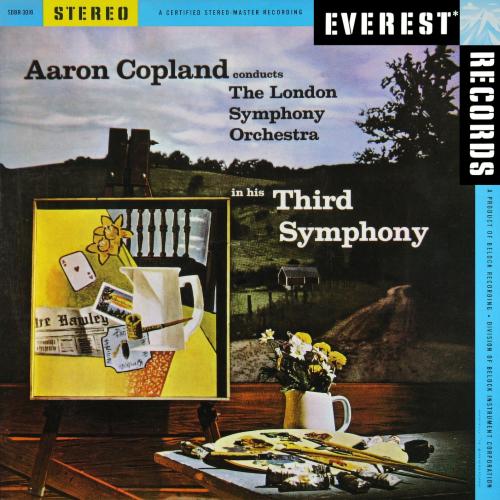
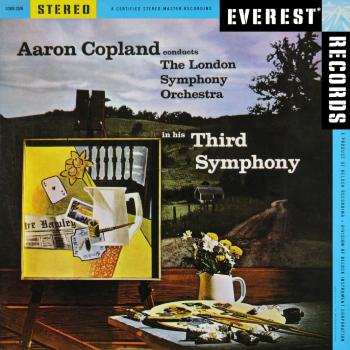
Copland: Symphony No. 3 (Transferred from the Original Everest Records Master Tapes) London Symphony Orchestra & Aaron Copland
Album info
Album-Release:
2013
HRA-Release:
14.01.2026
Label: Everest
Genre: Classical
Subgenre: Orchestral
Artist: London Symphony Orchestra & Aaron Copland
Composer: Aaron Copland (1900-1990)
Album including Album cover Booklet (PDF)
I`m sorry!
Dear HIGHRESAUDIO Visitor,
due to territorial constraints and also different releases dates in each country you currently can`t purchase this album. We are updating our release dates twice a week. So, please feel free to check from time-to-time, if the album is available for your country.
We suggest, that you bookmark the album and use our Short List function.
Thank you for your understanding and patience.
Yours sincerely, HIGHRESAUDIO
- Aaron Copland (1900 - 1990): Symphony No. 3:
- 1 Copland: Symphony No. 3: I. Molto moderato (Remastered 2013) 09:30
- 2 Copland: Symphony No. 3: II. Allegro molto (Remastered 2013) 08:14
- 3 Copland: Symphony No. 3: III. Andantino quasi allegretto (Remastered 2013) 09:54
- 4 Copland: Symphony No. 3: IV. Molto deliberato (Fanfare) - Allegro risoluto (Remastered 2013) 12:39
Info for Copland: Symphony No. 3 (Transferred from the Original Everest Records Master Tapes)
Copland's symphonic legacy was secured with the Third Symphony. In the '40s, American composers were searching for The Great American Symphony, and Copland's big four-movement work filled the bill. Composed for Serge Koussevitzky and the Boston Symphony Orchestra, the jubilant full orchestral forces were a celebration of the end of WWII. Koussevitzky said, "There is no doubt about it — this is the greatest American symphony. It goes from the heart to the heart." The Symphony makes little or no use of folk materials, but Copland borrows from himself by incorporating his triumphant Fanfare for the Common Manin the last movement of this grand work.
“This earlier recording of Billy sounds fresher and more joyous than the remake, and is coupled with a broad and often heartfelt reading of Statements (especially in the ‘Subjective’ movement). And I far prefer the incisive and characterful Everest recording of the Third Symphony! The quality of the Everest remastering is so good and the playing of the LSO so impressive that this is a vital embodiment of Copland’s intentions.” (Rob Cowan, Gramophone)
"Frankly, everyone involved had a right to be proud. The composer manages to successfully convey his unique sound to his London forces, and they responded with maximum effort. It's a performance that every Copland fan needs to hear, especially fans that don't usually warm to the composer's own efforts with a baton." (Brian Wigman, classical.net)
London Symphony Orchestra
Aaron Copland, conductor
Digitally remastered

Aaron Copland
Composer; born November 14, 1900 Brooklyn, New York; died December 2, 1990.
In a career that spanned over 50 years, Aaron Copland has earned the title, "Dean of American Composers." He is perhaps the most honored and best known composer of our time.
Copland was born in Brooklyn on November 14, 1900, the youngest of five children. He spent the first 20 years of his life here. As a child, he longed to study piano, but was forced to settle for lessons from one of his sisters. After graduating from high school, Copland decided to make music his career. He encountered his share of failures during his first years as a musician. His first teacher considered his modernisitc chords to be sour notes, and his efforts at composition during a trip to Paris in 1920 went unnoticed. The young Copland persevered, however, and under the instruction of Nadia Boulanger, a well-known teacher of harmony, he continued to compose.
Copland returned to the United States three years later only to face more disappointing reactions to his composing endeavors. He decided to settle for a job playing piano in a trio at a Pennsylvania hotel. While he was a member of the trio, Boulanger asked him to write an organ concerto for her. During his off hours, Copland worked on the concerto, a piece that would eventually be written without organ to become his "First Symphony."
His "First Symphony" premiered in 1925 by the New York Symphony Orchestra. Conductor, Walter Damrosch, expressed his feelings about Copland's work by saying, "If a young man (age 25) can write a symphony like that, in five years he will be ready to commit murder." A few months later, in Boston, Serge Koussevitsky conducted the premiere of Copland's jazzy "Music for the Theater." The positive reception of this piece prompted him to continue experimenting with jazz, resulting in his "Piano Concerto."
In 1936, Copland began to change his style, concentrating on folk themes. He wrote music for high school musicians before moving on to ballet on American themes, such as Billy the Kid (1938), Rodeo (1942), and Appalachian Spring (1944). Among the many awards Copland received are, an Oscar for Best Dramatic Film Score for The Heiress in 1949, the Pulitzer Prize for Appalachian Spring in 1944, the Presidential Medal of Freedom from President Johnson, and the National Medal of Arts in 1986.
In 1985, the year of Copland's 85th birthday, more than 100 American music organizations joined in a celebration on a scale never before accorded an American-born composer. The celebration began in April 1985 with a performance of his "Symphony No. 3" by the Philadelphia Orchestra and ended with another performance of the symphony by the National Symphony in Washington in May of the following year. Copland, in failing health, attended one concert at Lincoln Center in New York on his actual birthday, November 14. Copland's last public appearance was at an Aaron Copland Day celebration at the Berkshire Music Center in Tanglewood, Massachusetts on July 24, 1985. Leonard Bernstein conducted the center's student orchestra in the "Third Symphony." Copland died after a long illness, in North Tarrytown, New York, on December 2, 1990, at the age of 90.
Booklet for Copland: Symphony No. 3 (Transferred from the Original Everest Records Master Tapes)