



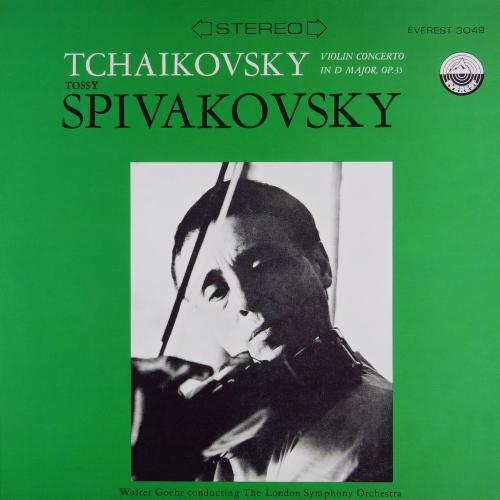
Tchaikovsky: Violin Concerto in D Major & Melody, Op. 42, No. 3 (Transferred from the Original Everest Records Master Tapes) London Symphony Orchestra, Tossy Spivakovsky & Walter Goehr
Album info
Album-Release:
2013
HRA-Release:
15.01.2026
Label: Everest
Genre: Classical
Subgenre: Concertos
Artist: London Symphony Orchestra, Tossy Spivakovsky & Walter Goehr
Composer: Piotr Ilyich Tchaikovsky (1840-1993)
Album including Album cover Booklet (PDF)
I`m sorry!
Dear HIGHRESAUDIO Visitor,
due to territorial constraints and also different releases dates in each country you currently can`t purchase this album. We are updating our release dates twice a week. So, please feel free to check from time-to-time, if the album is available for your country.
We suggest, that you bookmark the album and use our Short List function.
Thank you for your understanding and patience.
Yours sincerely, HIGHRESAUDIO
- Pyotr Ilyich Tchaikovsky (1840 - 1893): Violin Concerto in D Major, Op. 35:
- 1 Tchaikovsky: Violin Concerto in D Major, Op. 35: I. Allegro moderato (Remastered 2013) 18:33
- 2 Tchaikovsky: Violin Concerto in D Major, Op. 35: II. Canzonetta. Andante (Remastered 2013) 06:48
- 3 Tchaikovsky: Violin Concerto in D Major, Op. 35: III. Finale. Allegro vivacissimo (Remastered 2013) 09:38
- Souvenir d'un lieu cher, Op. 42:
- 4 Tchaikovsky: Souvenir d'un lieu cher, Op. 42: III. Mélodie. Moderato con moto (Remastered 2013) 04:13
Info for Tchaikovsky: Violin Concerto in D Major & Melody, Op. 42, No. 3 (Transferred from the Original Everest Records Master Tapes)
In music, we have the three great Bs – Bach, Beethoven and Brahms; and among violin concerti, there are the three great D Majors – the works in that key by Beethoven, Brahms and Tchaikovsky. Like its two companions, the third of these concerti requires a true virtuoso to reveal it in its proper light. Fortunately, such a virtuoso is Tossy Spivakovsky. Fortunately, too, Spivakovsky has the benefit of today’s finest recorded sound – Everest sound.
In the spring of 1878, Tchaikovsky and his brother Anatol were in Clarens, Switzerland, where the composer had been brought to recuperate from the effects of his disastrous, short-lived marriage with Antonina Ivanova Miliukov. With the two brothers was the violinist, Joseph Kotek, a former pupil of Joachim.
It was at this time that Tchaikovsky first became acquainted with Lalo’s Symphonie Espagnole for Violin and Orchestra, and he wrote to his „beloved friend,“ Mme. von Meck, praising the work most highly. Many believe that it was his contact with the Symphonie Espagnole that gave Tchaikovsky the sudden inspiration to drop everything else he was doing and write a violin concerto. There is, in fact, an actual similarity of melody and mood between the slow movements of the two works. Of course, the presence of Kotek must also have had something to do with the composition of the concerto, for he and the composer discussed it at length during the period of its creation.
It took Tchaikovsky only one month to write the Violin Concerto, and this included the complete rewriting of the second movement. The work was finished at the end of April, 1878.
TOSSY SPIVAKOVSKY was born in Odessa, but was taken to Berlin before he was two. After studies with Arrigo Serato and Willi Hess, he made his debut there at the age of ten. Fours of Europe, Australia and New Zealand followed. From 1933 to 1940, Spivakovsky taught at the University Conservatorium of Melbourne. In the latter year, he came to the United States, which has remained his home ever since. For three seasons, from 1942 to 1945, he served as concertmaster of The Cleveland Orchestra. Since that time he has been concertizing throughout the world. Everywhere he is acclaimed for his brilliant virtuosity.
London Symphony Orchestra
Tossy Spivakovsky, violin
Walter Goehr, conductor
Digitally remastered
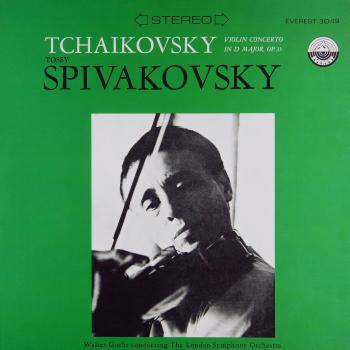
Tossy Spivakovsky
(1906-1998), violinist and teacher, made his performance debut as a ten-year-old prodigy, began touring Europe at thirteen and studied violin at Berlin’s Hochschule fur Musik before forming the Spivakovsky Duo with his older brother, pianist Jascha Spivakovsky, in 1920. At eighteen Tossy became concertmaster of the Berlin Philharmonic Orchestra, but he resigned the following year. The Spivakovsky duo performed in a number of European countries before they teamed with cellist Edmund Kurtz in 1930. Three years later, the trio were to settle in Melbourne, where Tossy and Kurtz were both engaged to teach at the Conservatorium. In Melbourne Tossy was joined by his fiancée, philologist Dr Erika Lipsker-Zarden, who fled Germany in late 1934; they were married at the end of that year, and she taught Spanish at the University of Melbourne from 1936 to 1939. The trio performed regularly around the country and were often on the wireless; in March 1939 the brothers gave a concert to raise funds for European refugees on behalf of the Jewish Democratic Cultural League. In 1940 Tossy and Erika moved to the USA, where they lived for the rest of their lives, Tossy appearing as a soloist with major orchestras and teaching for fifteen years at Juillard. He played a 1721 Stradivarius, and his idiosyncratic technique gave rise to the book The Spivakovsky Way of Bowing by Gaylord Jost. Jascha, who married an Adelaide girl, was to remain in Melbourne until his death in 1970. Although Tossy was particularly renowned for his interpretations of Tchaikovsky and Sibelius, at the time of Jascha’s death in Toorak the pair was planning to record Beethoven’s violin and piano sonatas. Their brothers Issy and Adolf both moved to Melbourne, too; Issy taught violin, viola and cello at Scotch College for 28 years, and Adolf taught singing at the Conservatorium.
Walter Goehr
Born into a German-Jewish mercantile family, Walter Goehr showed early signs of exceptional musical gifts. After studying in Berlin at the Stern Academy and at the Prussian Academy of Arts, where he was a pupil of Schoenberg, he became musical director of the Reinhardt Theatre in Berlin. Here in 1927 he conducted Kurt Weill’s incidental music for a production of Strindberg’s play Gustav III directed by Victor Barnowsky. Between 1925 and 1931 Goehr was a staff conductor for Berlin Radio, where he composed the music for an early radio opera, Malpopita. With the rise to power of the National Socialist Party he left Germany and emigrated to England, where until 1948 he was known professionally as George Walter. Having been appointed musical director for the Columbia Graphophone Company, by then a part of EMI, in 1933, Goehr remained with the company until 1939 and recorded extensively for both the Columbia and HMV labels. In 1943 he became conductor of the Morley College concerts, a position which he retained for the rest of his life, and in addition was the conductor of the BBC Theatre Orchestra from 1945 to 1948.
As well as being a proponent of composers such as Schoenberg and Eisler, Goehr was also a strong supporter of emerging British composers. He conducted the first performances of Benjamin Britten’s Serenade with Peter Pears and Dennis Brain (1943), Michael Tippett’s A Child of Our Time (1944), Mátyás Seiber’s Ulysses (1949), and The Deluge composed by his own son Alexander (1959). He was himself an active composer, writing music for films, such as the British productions Spellbound (1940) and Great Expectations (1946), and for numerous radio programmes, for which he would also often skilfully adapt music from many different sources. He orchestrated Mussorgsky’s Pictures at an Exhibition; and edited for performance Monteverdi’s L’incoronazione di Poppea, which he recorded, and the Vespers of 1610, which he conducted at York in 1954. He conducted the first British performance of Mahler’s Symphony No. 6 in 1950.
During the last decade of his life Goehr made a huge number of recordings for the Concert Hall Society, founded by the Josefowitz brothers. These records were sold by mail order in the USA, Europe and Australasia on a variety of labels such as Musical Masterpiece Society, La Guilde Internationale du Disque and Concert Hall. The recordings were also licensed to many other labels, with occasional changes to the performers’ credits: on the Classics Club label for instance Goehr’s name was occasionally adapted to Werner Tergorsky. His considerable experience as a radio and recording conductor, able to extract from orchestras polished performances under studio conditions and often without the luxury of extensive retakes, was clearly a factor in explaining his success in this role. However not many of these recordings received either media coverage or extensive reviewing, and so Goehr’s achievement has tended to be significantly under-rated. He died unexpectedly at the end of 1960 as a result of a heart attack, in Sheffield where he was conducting a performance of Handel’s Messiah.
Many of Goehr’s recordings show a strong musician at work, and often his performances contain a satisfying balance of style and energy. Among his pre-war recordings of note are Bizet’s Symphony in C, recorded with the London Philharmonic Orchestra for the HMV label, and many concerto accompaniments, such as the Schumann Piano Concerto with Dame Myra Hess, Mendelssohn’s Piano Concerto No. 1 with Ania Dorfman, and Tchaikovsky’s Piano Concerto No. 1 with Egon Petri, all of which were published on the Columbia label. Later EMI issued a recording of Goehr conducting the Philharmonia Orchestra in Tippett’s Concerto for Double String Orchestra, which helped to establish the composer’s name. Among the highlights of his Concert Hall discography are Haydn’s Symphonies Nos 46 and 96, Mozart’s Divertimenti in D, B flat and F, Beethoven’s Symphony No 5, Bruckner’s Symphony No. 3, Tchaikovsky’s Suites Nos 1, 2 and 3 and The Voyevoda, Elgar’s Enigma Variations, complete accounts of Bach’s Mass in B minor, Haydn’s Die Jahreszeiten, and Beethoven’s Missa Solemnis, and excerpts from Monteverdi’s L’incoronazione di Poppea, to name just a few.
Goehr was also a prolific accompanist for the label, making many recordings with soloists such as the violinists Riccardo Odnoposoff and Manoug Parikian, cellist Paul Tortelier, and pianists Artur Balsam and Grant Johannesen. Of especial interest among this group of recordings are those which Goehr made with the Australian pianist Noel Mewton-Wood. These included Beethoven’s Concerto No. 4, Chopin’s Concertos Nos 1 and 2, the concertos by Schumann, Stravinsky and Bliss, Tchaikovsky’s Concertos Nos 1, 2, 3 and the Concert Fantasy, and Shostakovich’s Concerto No. 1 for Piano and Trumpet. The commercial penetration of the Concert Hall organisation was extensive, and through his numerous recordings for the label, Walter Goehr became a significant figure in the general public’s post-war musical world.
Booklet for Tchaikovsky: Violin Concerto in D Major & Melody, Op. 42, No. 3 (Transferred from the Original Everest Records Master Tapes)