

Toronto Symphony Orchestra & Seiji Ozawa
Biography Toronto Symphony Orchestra & Seiji Ozawa
Toronto Symphony Orchestra
For over a century, the Toronto Symphony Orchestra (TSO) has played a fundamental role in shaping and celebrating Canadian culture. With a storied history of acclaimed concerts and recordings, Canadian and international tours, and impactful community partnerships, the orchestra is dedicated to engaging and enriching local and national communities through vibrant musical experiences. Music Director Gustavo Gimeno brings an expansive artistic vision, intellectual curiosity, and sense of adventure to programming the 93-musician orchestra that serves Toronto—one of the world’s most diverse cities.
As a group of artists, teachers, and advocates who share the belief that music has the power to heal, inspire, and connect people from all walks of life, the TSO engages audiences young and old through an array of education, community access, and health and wellness initiatives: The 2023/24 season marks the 50th anniversary of the TSO-affiliated Toronto Symphony Youth Orchestra—a tuition-free training program dedicated to cultivating the next generation of Canadian artists. It holds open houses and free concerts for members of the public at its longtime home of Roy Thomson Hall. Its Relaxed Performances are designed to be more welcoming for neurodiverse patrons, including those on the autism spectrum, and those with sensory and communication disorders, ADHD, and dementia. Art of Healing, its partnership with the Centre for Addiction and Mental Health, supports First Nations, Inuit, and Métis patients through musical storytelling and composition. TSOUND Connections harnesses music and technology to connect TSO musicians with seniors in care, to reduce social isolation and support well-being. Its Morning with the Toronto Symphony Orchestra program offers Open Rehearsals for high school music students from across the Greater Toronto Area. And, in partnership with the Toronto Public Library, Symphony Storytime features Orchestra members performing live alongside the reading of children’s stories, expanding access for families and children to literacy and music education.
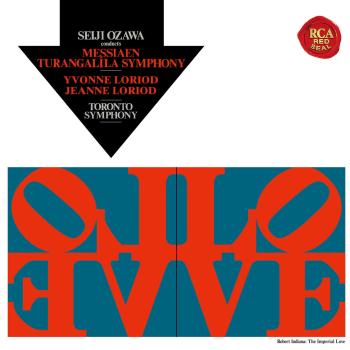
Since the orchestra’s first release in 1952, recordings have been an integral component of the TSO’s artistic legacy. Of the more than 150 titles in its discography, many have been nominated for prestigious awards. Most recently, our 2019 recording of works by Vaughan Williams, under TSO Conductor Emeritus Peter Oundjian, and 2021 recording of Massenet’s Thaïs, under TSO Conductor Laureate Sir Andrew Davis, both on Chandos, won JUNO Awards, with the former also receiving a GRAMMY® nomination. This recording marks the TSO’s first collaboration with Harmonia Mundi and its second recording of Turangalîla-Symphonie. The first was made in 1968 on RCA, under then–Music Director Seiji Ozawa. It also earned a GRAMMY® nomination and is widely considered to be a definitive interpretation of Messiaen’s masterwork.
Seiji Ozawa
For more than half a century, Seiji Ozawa was an icon for concert and opera audiences in Europe, North America, and Japan, as well as a steadfast advocate for young musicians. Born in 1935 in Mukden, Manchuria (now Shenyang, China), he graduated in both composition and conducting from Tokyo’s Toho School of Music. In 1959, he won first prize at the International Competition of Orchestra Conductors in Besançon, France, where he came to the attention of Boston Symphony Music Director Charles Munch, who invited him to Tanglewood, where he won the Koussevitzky Prize as the outstanding student conductor in 1960. While working with Herbert von Karajan in Berlin, Ozawa came to the attention of Leonard Bernstein, who appointed him assistant conductor of the New York Philharmonic for the 1961–62 season. He made his first professional concert appearance in North America in 1962 with the San Francisco Symphony.
Ozawa’s series of major appointments began with the music directorship of the Ravinia Festival, followed by the role of Music Director of the Toronto Symphony Orchestra and of the San Francisco Symphony. He first conducted the Boston Symphony Orchestra at Tanglewood and was subsequently named Tanglewood Artistic Director in 1970 and Boston Symphony Music Director in 1973, holding that post for 29 seasons – the longest-serving music director in the orchestra’s history. He left a legacy of brilliant achievement evidenced through touring, award-winning recordings (more than 140 works of more than 50 composers on 10 labels), television productions (winning 2 Emmy awards) and commissioned works. 1994 saw the inauguration of the Seiji Ozawa Hall at Tanglewood.
In Japan, Ozawa formed the Saito Kinen Orchestra with Kazuyoshi Akiyama in 1984 to commemorate their late mentor, Hideo Saito. The orchestra held hugely successful concerts in Tokyo and Osaka and went on to tour Europe in 1987, 1989 and 1990. In 1991, it performed concerts in Europe and America and was received to great acclaim. These activities led to the inception of Ozawa’s artistic dream in 1992: the Saito Kinen Festival Matsumoto. Ozawa became director of this international music festival, a role that continued until his death in 2024. From 2015, the festival was renamed the Seiji Ozawa Matsumoto Festival. Ozawa also founded an academy for aspiring orchestral players and in Switzerland, he founded an international music academy dedicated to training young musicians in chamber music. From 2002 to 2010, Ozawa was Music Director of the Wiener Staatsoper, and he was for many years a favourite guest of the Wiener Philharmoniker. He also maintained close ties to the Berliner Philharmoniker and the Orchestre National de France.
Ozawa’s discography for the Universal labels is immense and, as a uniquely sympathetic partner, he made many acclaimed recordings with such artists as Renée Fleming, Gidon Kremer, Viktoria Mullova, Anne-Sophie Mutter, Itzhak Perlman, Mstislav Rostropovich, and Krystian Zimerman.
Ozawa won many awards in Japan and abroad, including: the Asahi Prize (1985); an Honorary Doctorate from Harvard University (2000); the Austrian Cross of Honour for Science and Art, First Class (2002); the Mainichi Art Award (2003); the Suntory Music Prize (2003); an Honorary Doctorate from the Sorbonne University of France (2004); Honorary Membership from the Wiener Staatsoper (2007); France’s Officier de la Légion d’Honneur (2008); Foreign Associated Member in the Académie des Beaux-Arts de l’Institut de France (2008); the Order of Culture, which is the highest honor in Japan (2008); Giglio D’Oro by Premio Galileo 2000 Foundation of Italy (2008); the first Japanese national to be bestowed honorary membership to the Vienna Philharmonic (2010); the Praemium Imperiale from the Japan Art Association (2011); the Akeo Watanabe Foundation Music Award (2011); and the Kennedy Center Honors (2015). In February 2016, the Ravel L’enfant et les sortilèges album conducted by Seiji Ozawa and performed by the Saito Kinen Orchestra that was recorded at the 2013 Saito Kinen Festival Matsumoto won the 58th Grammy Award for Best Opera Recording. In April 2016, he was named an Honorary Member of the Berliner Philharmoniker.
“The warmth, generosity and sense of humour that Seiji Ozawa radiated in personal encounters and conversations are among the most memorable experiences for anyone who had the pleasure to meet him, and he inspired so many young talents with his aura, advice and selfless support. He will be very much missed.”