
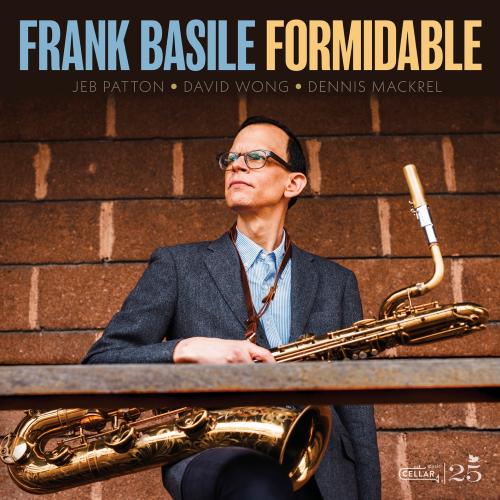
Formidable Frank Basile
Album info
Album-Release:
2026
HRA-Release:
20.11.2026
Album including Album cover
- 1 The Lion’s Share 07:10
- 2 Formidable 05:38
- 3 Crazy 05:25
- 4 I Wished I Knew 09:16
- 5 Down In Brazil 06:22
- 6 Interloper 08:49
- 7 Tomorrow Night 06:14
- 8 Omaha 06:33
Info for Formidable
As the title of this fine album’s lead-off track suggests, the great New York-based saxophonist Frank Basile assumes the “lion’s share” of solo space and improvisatory room on 2026’s Formidable. And why not? Basile is a gifted jazz improvisor blessed with a honeyed tone, bebop-infused language for days, and a rhythmic pulse that would swing any musical aggregation into next week! And while this turn to the spotlight may be a slight anomaly in a fêted career that has included considerable recording experience with some of jazz music’s finest big bands, the prioritizing of the soloist/bandleader side of Basile’s musical personality is, as he told me from his adopted home of New York City, the realization of a formative musical desire. “That’s always been the goal,” states Basile conclusively, “but due to the nature of being a baritone saxophonist, a lot of the calls I get are for big bands, which I also find very fulfilling. But it has always been my desire to be a small group jazz soloist.” And while said desire has undoubtedly been fulfilled to a certain extent through his terrific co-led work, with Formidable, the first “solo horn fronting a rhythm section” album in Basile’s already impressive discography, he gets the opportunity.
Assembling a blue-chip ensemble in Jeb Patton, David Wong, and Dennis Mackrel, Basile sets the tone early with the aforementioned, “The Lion’s Share,” an original blues. “I’m influenced by Bird, of course,” states Basile, “and by all the great soloists whom we love. But this track was written for Leo Parker whom, in addition to being an unsung hero of bebop and of the baritone, was one of my earliest influences.” Widely credited as the first soloist to transfer the sophisticated and ornate language of bebop onto the baritone saxophone, Parker’s influence on Basile, who foregrounds bebop inventiveness on Formidable, is obvious. “I have spent a lot of time thinking about what I want to sound like,” states Basile, “and Harry Carney, Leo Parker, Cecil Payne, Pepper Adams, Ronnie Cuber, and Gary Smulyan are the big six influences who most meaningfully shaped my approach.” The fact that Basile could both quickly, and chronologically, list these seminal players as impactful upon his style speaks to both his thoughtfulness as a perennial “student” of jazz, as well as to the attention to detail he brings to his disciplined musical approach.
Unsurprisingly, Basile took equal care in his choice of musicians for this project. “In addition to those horn players, I draw a lot of inspiration from the musicians with whom I play. And while these three gentlemen have been both long-time friends and collaborators, this is the first time that we have played together in this exact combination.” While the specific casting for this record may be new, the shared bandstand experience runs deep, dating back to Basile and Wong’s “turn of the century” meeting as students at Juilliard, to working with Patton in legendary tenor player Jimmy Heath’s big band, to a shared tenure in the Dizzy Gillespie All-Star Big Band with Dennis Mackrel. Suffice it to say, the pieces and collective histories were all there. Add in a program of swingers that includes Walter Davis Jr.’s singable title track (learned from a Donald Byrd recording), the deceptive simplicity of Roy Burrowes’ “Down in Brazil,” or the group’s medium tempo romp through “Tomorrow Night,” a tune made famous by Joe Williams with the Count Basie Orchestra, and you have the resulting efficacious and swinging ensemble album you currently hold in your hands!
Listen, for example, to “Omaha,” the Illinois-born, Nebraska-raised Basile’s contrafact (with a manipulated bridge) on Ray Noble’s classic war horse “Cherokee.” Taken at bright clip, Basile’s group immediately, and what sounds like easily, coalesces together with the shared imperative of a melody-forward swinging jazz statement that delicately balances everyone’s individual musical contributions within a cohesive ensemble experience. This time it is Patton who solos first, traversing the chord changes with the intricate line construction and rapid-fire comping that has earned him a reputation as among New York’s most in demand pianists. Next up is Basile, whom, to my ears, is most demonstrative here of the influence of Ronnie Cuber. Beginning his fiery improvisation with a “stop-time” chorus that would easily slot next to Cuber’s work on George Benson’s “The Cooker,” Basile is endlessly inventive, bringing a lyrical freshness and rhythmic buoyancy to this exhilarating album closer. And what can one say about the airtight bass and drum hook up of Wong and the legendary Mackrel [who was the final drummer hired by Count Basie] that anchors the entire proceedings? As Basile states definitively, “I couldn’t have asked for a better rhythm section than this!” Finally, add in the historic vibe and ephemeral spirit of influence that I imagine must come from recording in no less a sacrosanct jazz locale than Van Gelder Studio of Englewood Cliffs, and you have a top-shelf discographic contribution that, as the name rightly suggests, is truly “Formidable.” (Andrew Scott, Toronto)
Frank Basile, baritone saxophone
Jeb Patton, piano
David Wong, bass
Dennis Mackrel, drums
Recorded March 16, 2026 at Van Gelder Studio in Englewood Cliffs, NJ
Engineered by Maureen Sickler
Mixed and Mastered by Ian Hendrickson-Smith
Produced by Cory Weeds & Frank Basile
Executive Producer: Cory Weeds
Frank Basile
Since moving to New York in 2001, Frank Basile has been fortunate to establish himself as one of today's most in-demand baritone saxophonists.
Dubbed a "prized sideman" by The New Yorker, Basile has been called upon to perform with, record with, and tour the world with many of jazz's finest musicians and ensembles. Among this distinguished list are The Vanguard Jazz Orchestra, The Dizzy Gillespie All-Star Big Band, The Jimmy Heath Big Band, The Bob Mintzer Big Band, The Jon Faddis Jazz Orchestra, The Joe Lovano Nonet, The Dave Holland Big Band, Dennis Mackrel's Manhattan Symphony Jazz Orchestra, The Christian McBride Big Band, The Count Basie Orchestra, Michael Bublé, Pablo Mayor’s Folklore Urbano, The Richie Vitale Quintet, The Fabien Mary Quintet, and The Osian Roberts-Steve Fishwick Sextet.
Born in Illinois in 1978 and raised in Nebraska, Frank Basile began his musical studies in grade school. After four years on clarinet and alto saxophone, he made a permanent switch to the baritone saxophone. Once in high school, Basile’s interest in jazz began to grow and, with the help and encouragement of his parents, he sought out further instruction on the ins and outs of this great music. Basile was soon playing in numerous big bands and combos throughout the Omaha area.
Basile enrolled at the University of North Texas to continue his musical studies. While at UNT, Basile played in the world-renowned One O’clock Lab Band for six consecutive semesters. After graduating with honors and a bachelor’s degree in Jazz Studies from UNT, Basile moved to New York in the summer of 2001 as a selected member of the first Jazz Studies program at the Juilliard School.
As an educator, Basile has maintained a private studio for the past decade and has served as an adjunct faculty member at The New School. He has also been called upon to teach lessons or masterclasses at such institutions as New York University, the Eastman School of Music, Temple University, the University of North Carolina at Greensboro, SUNY Purchase, the University of Nebraska, and the New York Youth Symphony Jazz Orchestra.
In addition to his activities as a sideman and educator, Basile also takes an active role as leader of his own quartet, quintet and sextet. To date, Basile has released three recordings as a leader, and his band has headlined at many of New York's major jazz clubs.
This album contains no booklet.