






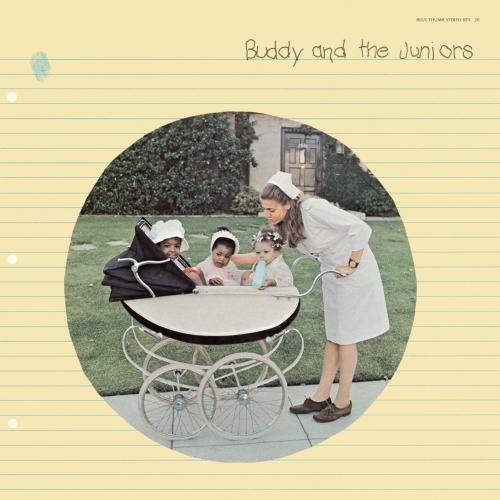
Buddy And The Juniors (2025 Remaster) Buddy Guy, Junior Mance, Junior Wells
Album info
Album-Release:
2026
HRA-Release:
30.01.2026
Album including Album cover
I`m sorry!
Dear HIGHRESAUDIO Visitor,
due to territorial constraints and also different releases dates in each country you currently can`t purchase this album. We are updating our release dates twice a week. So, please feel free to check from time-to-time, if the album is available for your country.
We suggest, that you bookmark the album and use our Short List function.
Thank you for your understanding and patience.
Yours sincerely, HIGHRESAUDIO
- 1 Talkin' 'Bout Women Obviously 09:49
- 2 Riffin' (a.k.a A Motif Is Just A Riff) 07:30
- 3 Buddy's Blues 03:25
- 4 (I'm Your) Hoochie Coochie Man 05:15
- 5 Five Long Years 05:51
- 6 Rock Me Mama 05:36
- 7 Ain't No Need 04:31
Info for Buddy And The Juniors (2025 Remaster)
One of Chicago blues' most dynamic duos, Buddy Guy and Junior Wells, together with the talented pianist Junior Mance on the sensational Buddy and the Juniors. Originally issued in 1970 by Blue Thumb Records and deservedly back in print, Buddy and the Juniors came about when then-fledgling producer Michael Cuscuna (and future jazz-producing legend) tried to rustle up some dough to finish a Buddy Guy project for Vanguard (the label refused to pay for the star's plane ticket to a mixing session) by booking a fast cheap date with the two Juniors.
In 1969, guitarist Buddy Guy got together with his old Chicago blues pal Junior Wells, added in jazz pianist Junior Mance, and cut a loose, "unplugged" session for Blue Thumb Records that would become the now-legendary album "Buddy And The Juniors". Buddy and the two Juniors were relaxed, cutting familiar tunes like Willie Dixon's "Hoochie Coochie Man" and their own off-the-cuff originals, including "Buddy's Blues." Additionally, two improvised tracks were recorded in a single burst of creative energy: "Talkin' 'Bout Women Obviously" and "Riffin’”, all making for a fresh, inviting, and inspiring album.
Buddy Guy released his most recent record, The Blues Don’t Lie, in 2022. But his music—and technical skill—has seen renewed interest this year after his appearance in Ryan Coogler’s 2025 hit film Sinners, which chronicles a harrowing opening night at turn-of-the-century juke joint in Alabama, operated by twins Smoke and Slim (both played by Michael B. Jordan). In the film, Guy portrays an adult version of a key character with a gift for rhythm and blues.
Although Wells died in 1998 and Mance in 2021, their bodies of work have also continued to endure. Wells’ 1965 record Hoodoo Man Blues (which features Guy on guitar) is considered one of the finest examples of the genre in the ‘60s—over the course of Wells’ career, he would also collaborate with the likes of Junior Parker, Sonny Boy Williamson, Derek Trucks and The Rolling Stones.
Mance also continued to make music, consistently releasing albums for three decades including 1995’s Blue Mance and 2015’s For My Fans…It’s All About You, which he released via Kickstarter. He and his wife founded the record label JunGlo together in 2007—he also taught at The New School for Jazz and Contemporary Music for 23 years, before retiring in 2011.
"The historical details surrounding the recording session that became Buddy & the Juniors are almost as entertaining -- and oddly satisfying -- as the music itself. Released on Blue Thumb in 1970 on multi-colored wax, this session, was it not for a very real economic necessity due to Buddy Guy's feud with Vanguard Records, would never have happened. It appears that Vanguard wouldn't pick up the tab for Guy to fly to New York to mix an album he'd cut with Junior Mance and Gary Bartz -- also produced by Cuscuna. Being an ever-enterprising genius, Cuscuna pitched the idea for a recording between Guy, Mance, and Junior Wells to Blue Thumb label boss Bob Krasnow, who jumped at the chance. The all-acoustic Buddy & the Juniors was recorded on December 18 of 1969, and on December 19, they mixed this album and the Vanguard date! While an acoustic pairing between Guy and Wells is a natural one, adding jazz pianist Mance -- a Chicago native whose early influences were the boogie-woogie recordings of Meade "Lux" Lewis and Albert Ammons -- to the mix was risky in terms of interpersonal dynamics, but in retrospect, proved a brilliant idea. The proceedings are informal and raw with plenty of fireworks. The first two tracks -- "Talkin' 'Bout Women Obviously" and "Riffin' (aka A Motif Is Just a Riff)" -- were the last two recorded. They are blazing, hairy, on-the-spot improvisational duets between Wells and Guy: the former offers lyrics in a back-and-forth extemporaneous style; the latter develops in intensity as it goes on. The playing by Guy and Wells is inspirational. "Buddy's Blues," the first interplay of the trio, has Mance digging deeply into the Otis Spann tradition, just rolling inside it, accenting lines, punching chords, and offering beautiful tags to Wells' harmonica lines. Wells' vocal on "(I'm Your) Hoochie Coochie Man" meets Guy's six-string head-on, with Mance comping and popping a melodic fill underneath each sung phrase. He introduces "Five Long Years" as a piano blues that gets countered in exponential grit by Guy's vocal and Wells' punchy harp; he shuffles, fills, trills, and blows straight at the keyboard, creating a forceful gale of dialogue. On the slippery boogie-woogie set closer, Wells' "Ain't No Need," the listener grasps the deep communication of this trio. Given how earthy, informal, and joyful this acoustic session is, it conveys everything right about Chicago blues." (Thom Jurek, AMG)
Buddy Guy, guitar, vocals
Junior Wells, harmonica, vocals
Junior Mance, piano
Digitally remastered
Buddy Guy
George “Buddy” Guy, one of the most dazzling performers in blues history, was born here in Lettsworth on July 30, 1936. His primary influences included local Louisiana musicians and many more who were born across the river in Mississippi, including B.B. King, Guitar Slim, Muddy Waters and John Lee Hooker. Guy’s connections with Mississippi blues remained vibrant throughout a monumental career as a recipient of multiple GRAMMY® and Blues Music Awards and inductee into the Blues and Rock and Roll Halls of Fame.
Buddy Guy, like his idol B.B. King, rose to the top of the blues world from humble beginnings as a sharecropper’s son. The Guy family lived in a house that stood about 250 feet south-southeast of this site on the Feduccia family’s Three Rivers Landing plantation. His father, Sam Guy, bought Buddy his first guitar from another fieldhand, Henry “Coot” Smith, who showed Buddy how to play John Lee Hooker’s “Boogie Chillen,” which was already the favorite record in the Guy household. Further inspired locally by Lightnin’ Slim, Buddy began playing in Baton Rouge with “Big Poppa” Tilley and Raful Neal (whose son Kenny later played in Buddy’s band). The flamboyance of Eddie “Guitar Slim” Jones left a lasting impression; Guy said: “I wanted to play like B.B. but act like Guitar Slim.” Guy recorded a demo tape on May 30, 1957, for WXOK DJ “Diggie Doo” Meaders, who sent a copy to Ace Records in Jackson, but those songs were not released until years later.
On September 25, 1957, Guy, who had been working as a utility man at LSU, left home for Chicago in hopes of finding a better job and pursuing his music. He found the Windy City blues scene dominated by transplanted Southerners, more from Mississippi than any other state. Mississippians Otis Rush and Muddy Waters were among the first to befriend and encourage him, and Willie Dixon supervised most of his early recording sessions for the Artistic and Chess labels. Guy’s incendiary act electrified audiences in Chicago and on tour, but he also proved himself a versatile and sympathetic accompanist, recording behind Muddy and other Mississippi-born bluesmen, including Eddie Boyd, Honeyboy Edwards, John Lee Hooker, Walter Horton, Son House, Howlin’ Wolf, Sunnyland Slim, Jesse Fortune and Sonny Boy Williamson No. 2 in the 1960s.
Among Guy’s classic early records were one single, “Stone Crazy,” that briefly hit the Billboard magazine charts in 1962; several Willie Dixon compositions; and “My Time After While,” a prophetic title. Although Guy remained an exciting and frenetic entertainer, major success as a recording star eluded him for decades. He often teamed with West Memphis native Junior Wells in town and on tour, and sometimes appeared with B.B. King or with rock stars he had influenced, including Eric Clapton, Jimi Hendrix and Stevie Ray Vaughan. He further enriched the Chicago scene by launching the Checkerboard Lounge in 1972 and Buddy Guy’s Legends in 1989, providing venues for his fellow blues artists, again including countless Mississippians.
Buddy Guy’s time came in 1991 with the breakthrough of Damn Right, I’ve Got the Blues, the first of his many albums to reach the Billboard charts. His CDs Sweet Tea, his first to hit No. 1 on the Billboard blues charts in 2001, and Blues Singer, both laced with Guy’s renditions of Mississippi blues, were recorded in Oxford, Mississippi. The cover of The Blues Is Alive and Well, another No. 1 blues CD in 2018, pictured Guy back in Lettsworth, a testament to a legendary bluesman who never forgot his roots and the people who nurtured his extraordinary talent. (Source: Mississippi Blues Commission)
This album contains no booklet.