

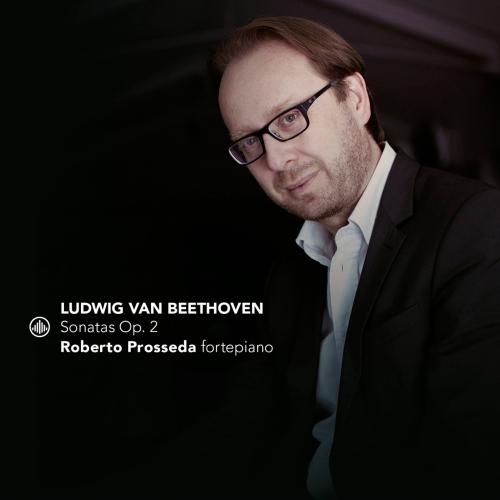
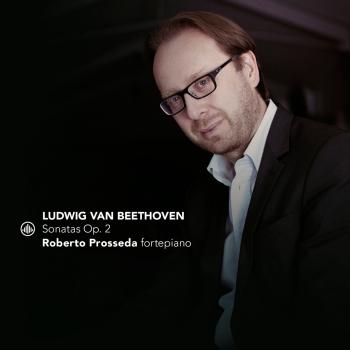
Ludwig van Beethoven: Sonatas Op. 2 Roberto Prosseda
Album info
Album-Release:
2024
HRA-Release:
04.10.2024
Label: Challenge Classics
Genre: Classical
Subgenre: Instrumental
Artist: Roberto Prosseda
Composer: Ludwig van Beethoven (1770-1827)
Album including Album cover
- Ludwig van Beethoven (1770 - 1827): Sonata Op. 2, No. 1 in F Minor:
- 1 Beethoven: Sonata Op. 2, No. 1 in F Minor: I. Allegro 05:14
- 2 Beethoven: Sonata Op. 2, No. 1 in F Minor: II. Adagio (Fa maggiore) 04:51
- 3 Beethoven: Sonata Op. 2, No. 1 in F Minor: III. Minuetto. Allegretto 02:40
- 4 Beethoven: Sonata Op. 2, No. 1 in F Minor: IV. Prestissimo 04:23
- Sonata Op. 2, No. 2 in A Major:
- 5 Beethoven: Sonata Op. 2, No. 2 in A Major: I. Allegro vivace 06:54
- 6 Beethoven: Sonata Op. 2, No. 2 in A Major: II. Largo appassionato 06:03
- 7 Beethoven: Sonata Op. 2, No. 2 in A Major: III. Scherzo. Allegretto 03:36
- 8 Beethoven: Sonata Op. 2, No. 2 in A Major: IV. Rondo 07:14
- Sonata Op. 2, No. 3 in C Major:
- 9 Beethoven: Sonata Op. 2, No. 3 in C Major: I. Allegro con brio 10:22
- 10 Beethoven: Sonata Op. 2, No. 3 in C Major: II. Adagio 07:24
- 11 Beethoven: Sonata Op. 2, No. 3 in C Major: III. Scherzo 03:27
- 12 Beethoven: Sonata Op. 2, No. 3 in C Major: IV. Allegro. Assai 05:28
Info for Ludwig van Beethoven: Sonatas Op. 2
For his debut release on Challenge, Roberto Prosseda has chosen to record the three Sonatas op. 2 by Beethoven, and for a more personal interpretation, he has selected to perform on aGraf fortepiano dated 1820.
Can something new, interesting and 'true' still be said about the interpretation of Beethoven's sonatas? I believe so, provided we break out of the conventions created by the tradition of interpretation and discography, where in 98% of cases a modern piano is used. Therefore, I thought that the choice of recording Beethoven on a historical instrument could also be a way for a more individual interpretative investigation, free from the models that listening to famous recordings on a modern piano risks accustoming us to.I do not believe that there is a 'right' and a 'wrong' instrument on which to perform Beethoven's Sonatas Opus 2. What matters is the musical result. It depends on the alchemy that is created between the performer and the instrument.Before I came to choose the Graf No. 429, I tried at length various modern copies of fortepiano from 1795 - 1800, trying to get closer to the sound and expressive world of early Beethoven.However, having the opportunity of having a Graf fortepiano (No. 429) in my studio, restored in 2023, I was able to prepare this recording on that instrument, playing it regularly for a year, achieving a kind of familiarity with its action and timbral response that I have grown fond of. (from the liner notes of the album, by Robert Prosseda)
Roberto Prosseda, piano
Roberto Prosseda
born in Latina, Lazio, in 1975, is one of the most active and versatile Italian musicians on the current international scene. He gained international fame following his recordings of the complete Mendelssohn piano music (Decca, 2005-14), published in a box set in 2017.
Over the past twenty years Roberto has performed with some of the world’s leading orchestras and conductors. With the Gewandhausorchester and Riccardo Chailly, he recorded Mendelssohn’s then-unpublished E minor piano concerto. In Italy he is a regular guest at the major concert venues, including the Accademia Nazionale di Santa Cecilia, Teatro alla Scala, Unione Musicale in Turin, Teatro La Fenice, Accademia Chigiana (Siena) and Teatro Comunale (Bologna).
Roberto is particularly acclaimed for his interpretations of Mozart, Schubert, Schumann and Chopin. His six albums of Mozart piano sonatas for Decca have received considerable international acclaim. In 2022 Roberto completed a project to record the complete Mozart piano works. 2025 saw the release on Hyperion of War Silence, a collection of rare Italian piano concertos by Guido Alberto Fano, Luigi Dallapiccola, Silvio Omizzolo and Cristian Carrara, described in Gramophone magazine as ‘an absorbing listen’.
Since 2011 Roberto has also played the pedal piano in public, having re-discovered and presented in modern premieres various pieces by Alkan and Gounod’s Concerto for pedal piano and orchestra with Parma’s Filarmonica Arturo Toscanini. He has performed the latter also with the Berliner Symphoniker, Staatskapelle Weimar, Lahti Symphony and Netherlands Symphony orchestras, and for Hyperion recorded Gounod’s four pieces for pedal piano and orchestra with the Orchestra della Svizzera Italiana and Howard Shelley. Roberto has performed on the piano pedal in over 100 concerts, contributing to the revitalization of the instrument and its repertoire.
Roberto Prosseda is equally active as a music writer and author of radio and TV projects, as well as a creator of innovative musical programmes of international scope. He conceived three television documentaries, about Mendelssohn, Chopin and Liszt, directed by Angelo Bozzolini, produced by RAI and globally distributed by EuroArts. His book Il Pianoforte, a listening guide to piano repertoire, was published by Edizioni Curci in 2013.
This album contains no booklet.