



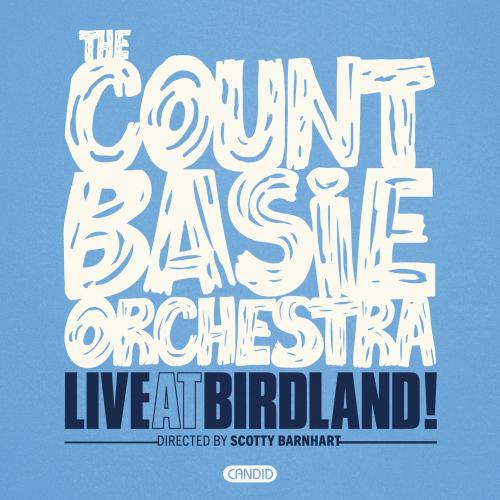
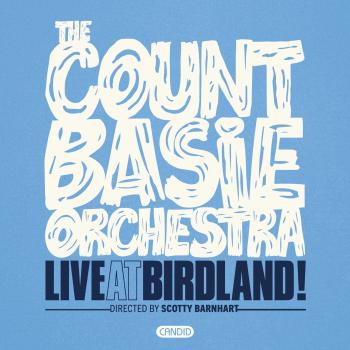
Live At Birdland The Count Basie Orchestra
Album Info
Album Veröffentlichung:
2021
HRA-Veröffentlichung:
05.03.2026
Das Album enthält Albumcover
- 1 Intro (Live) 00:17
- 2 The Kid From Redbank (Live) 03:13
- 3 Who, Me (Live) 05:10
- 4 Way Out Basie (Live) 05:06
- 5 In The Wee Small Hours Of The Morning (Live) 06:08
- 6 Doodle Oodle (Live) 02:53
- 7 Four Five Six (Live) 08:30
- 8 Basie Power (Live) 04:06
- 9 Honeysuckle Rose (Live) 03:22
- 10 Only The Young (Live) 04:58
- 11 I Can't Give You Anything But Love (Live) 03:06
- 12 Easin' It (Live) 07:23
- 13 What's New (Live) 05:09
- 14 Kansas City Shout (Live) 03:33
- 15 How Do You Keep The Music Playing (Live) 05:07
- 16 Basie (Live) 04:18
- 17 One 'O Clock Jump (Live) 03:50
- 18 Wind Machine (Live) 03:23
- 19 April In Paris (Live) 03:31
- 20 There Will Never Be Another You (Live) 02:48
- 21 I've Grown Accustomed To Her Face (Live) 04:13
- 22 I Needs To Be Bee'd With (Live) 05:23
- 23 Flute Juice (Live) 03:53
- 24 Moten Swing (Live) 05:33
- 25 Blues In Hoss' Flat (Live) 08:15
- 26 Once In A While (Live) 04:17
- 27 Five 'O Clock In The Morning (Live) 03:14
- 28 Shiny Stockings (Live) 05:36
- 29 What Kind Of Fool Am I (Live) 03:34
- 30 Deed I Do (Live) 02:42
- 31 From One To Another (Live) 10:56
- 32 Whirlybirds (Live) 05:33
- 33 One 'O Clock Jump (short) (Live) 01:19
Info zu Live At Birdland
Im Sommer 1961 spielten Count Basie und sein Orchester im legendären New Yorker Jazzclub Birdland, den Basie als seine musikalische Heimat betrachtete. Die Live-Aufnahme von zwei dieser Abende, Basie at Birdland!, gilt als die beste Live-Aufnahme einer Big Band aller Zeiten.
Fast 60 Jahre später kehrt das Count Basie Orchestra, das mittlerweile unter der Leitung von Scotty Barnhart steht und immer noch weltweit auftritt, ins Birdland zurück, um erneut eine Live-Platte aufzunehmen. Diese vier Abende im Januar 2020 sollten sich als schicksalhaft erweisen, da dieses Land und die ganze Welt kurz darauf einer globalen Pandemie zum Opfer fallen sollten und praktisch alle Live-Musikaufführungen für die nächsten anderthalb Jahre eingestellt wurden. Als die Menschen in dieser Woche in Scharen ins Birdland strömten, dachte noch niemand an die bevorstehenden Herausforderungen. Sie wussten, dass die Basie-Band nach wie vor eine ganz besondere Formation ist und dass vier Abende im Birdland besondere Momente versprachen. Die zusätzliche Live-Aufnahme machte diese Abende noch elektrisierender, und die Spannung im Raum war mit Händen zu greifen.
Live at Birdland fängt die aktuelle Band auf dem Höhepunkt ihrer Karriere ein und würdigt mit ihrer kraftvollen Mischung aus erfahrenen Veteranen und aufstrebenden Stimmen gleichzeitig die Tradition und den Blick nach vorne. Das Count Basie Orchestra behält das typische hohe musikalische Niveau bei, das wir seit 85 Jahren gewohnt sind.
John White vom Jazz Journal äußerte sich sehr positiv und schrieb, dass das Album „eine Mischung aus Basie-Favoriten des ‚Neuen Testaments‘ mit einigen überraschenden Ergänzungen bietet, [die] den Charakter der Originale bewahren“. Er fügte hinzu: „Die Band kann (und tut dies auch) bei einigen bekannten (aber adaptierten) Stücken richtig loslegen. [...] Pearson, Doug Lawrence und Barnhart spielen unvergessliche Soli, während die Band zunächst lautstark begleitet und dann etwas zurückhaltender wird.“ Er kam jedoch zu dem Schluss, dass das Album „erhebliche Vorzüge hat, aber ohne Basie selbst ist es eher wie ‚The Marx Brothers‘ ohne Groucho – nicht ganz authentisch.“ Matt Silver schrieb für WRTI: „Es gibt hier nicht viel Neues, nicht viel, was man als innovativ bezeichnen könnte – was auch immer dieses zunehmend nebulöse, aber allgegenwärtige Verdienstabzeichen überhaupt bedeutet. Und vielleicht ist dieses Album gerade deshalb musikalisch und konzeptionell so erfrischend.“
Scotty Barnhart, Direktor, Trompete
David Glasser, Lead-Altsaxophon, Flöte
Markus Howell, Altsaxophon, Flöte
Doug Lawrence, Tenorsaxophon
Doug Miller, Tenorsaxophon
Joshua Lee, Baritonsaxophon
Frank Green, Lead-Trompete
Shawn Edmonds, Trompete
Endre Rice, Trompete
Brandon Lee, Trompete
David Keim, Lead-Posaune
Clarence Hanks, Posaune
Mark Williams, Posaune
Alvin Walker, Bassposaune
Glen Pearson, Klavier
Will Matthews, Gitarre
Trevor Ware, Kontrabass
Robert „B.T.“ Boone Jr., Schlagzeug
Gäste:
Carmen Bradford, Gesang
Jamie Davis, Gesang
Butch Miles, Schlagzeug (Tracks 11, 12)
Aufgenommen live vom 15. bis 18. Januar 2020 im Birdland, New York City
Zur Info: wir bieten dieses Album in der nativen Abtastrate von 48kHz, 24-Bit an. Die uns zur Verfügung gestellte 96kHz-Version wurde hochgerechnet und bietet keinen hörbaren Mehrwert!
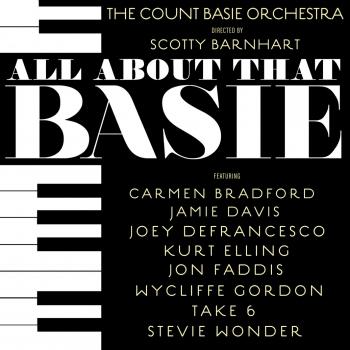
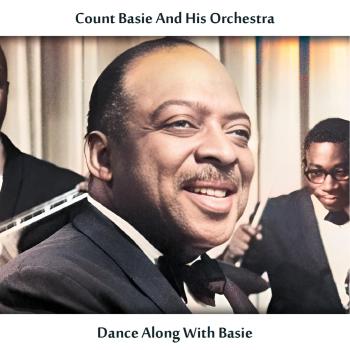

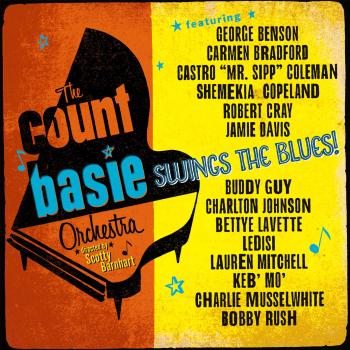
Count Basie
Born in Red Bank, New Jersey, in 1904, William "Count" Basie was not always the fabled "Count". He began his career as Bill Basie, an itinerant pianist who made his living pounding keys in theaters featuring silent movies and touring on the Theater Owners Booking Agency (TOBA) circuit, a hopscotch run of independent performance venues, in black communities stretching from East to West, North and South.
TOBA was also known as Tough On Black Artists, or less affectionately Tough On Black you-know-whats. In 1927, Basie, then touring with Gonzelle White and the Big Jazz Jamboree, found himself "high and dry" in Kansas City, Missouri. It was unlikely that Basie had followed Horace Greeley's actually John B.L. Soule's entreaty to "Go West young man" and his destiny was certainly not manifest.
As Basie recounted in his autobiography, Good Morning Blues, "I don't remember what my plans were at the time, but in the meantime I got sick and had to go to the hospital."
Nevertheless, for a musician of Basie's inclinations, Kansas City was not a bad place to be stranded. In the 1920's and 30's, Kansas City was headquarters for the territory bands that played the mid and southwest. KC was also a veritable cauldron for the heady mixture of blues principles, ineffably swinging rhythms and brilliant instrumentalists that coalesced into one of the signature sounds of American music, both popular in its appeal and substantial in its musical import.
Basie quickly fell in with the best of the territory bands, including Walter Page's Blue Devils and Benny Moten's Kansas City Orchestra. By 1935, Basie's destiny was becoming manifest. He had formulated and was leading the band that epitomized Kansas City Swing, the Count Basie Orchestra. Along with the bands of Fletcher Henderson, Duke Ellington and Benny Goodman, Basie's orchestra would define the big band era.
While the media of the time crowned Benny Goodman the "King of Swing", the real King of Swinging was undoubtedly The Count. Basie's achievements, however, would transcend the Swing Era as such. The Basie orchestra evolved into one of the most venerable and viable enterprises in American music, as meaningful in its legacy and continuing productivity as any musical organization of the 20th, and now, 21st century.
Interestingly, the critical consensus charaterizes the Basie lineage in Biblical terms, as the Old and New Testament bands. The Old Testament band's style has been summed as a combination of democratically developed, or head, riff-driven arrangements, dripping with blues essence and relaxed, but relentless, swing that showcased a who's who of very distinctive instrumentalists and vocalists: Lester Young, Hershel Evans, Harry Edison, Buck Clayton, Dicky Wells, Jo Jones, Freddie Green and Jimmy Rushing among others.
In the early 1950's, The "New Testament" Count Basie Orchestra rose Phoenix-like from the ashes of the Big Band era. For the last fifty plus years, the Count Basie Orchestra has been an arranger's palette. Thad Jones, Ernie Wilkins, Neal Hefti, Sammy Nestico, and Frank Foster, to name a few of the more prominent Basie's penmen, have added volumes to the Basie Library. Through them, the Basie repertoire has continued to broaden harmonically and rhythmically, making it more than hospitable to the talents of successive generations of musicians. As Basie allowed for certain measure of change and for a variety of voices to emerge on the platform he created, his remained the ultimate sensibility.
Since Basie's passing in 1984, Thad Jones, Frank Foster, Grover Mitchell, Bill Hughes and now Dennis Mackrel have led the Count Basie Orchestra and maintained it as one of the elite performing organizations in Jazz.
Current members include musicians hired by Basie himself: John Williams (joined in 1970), Dennis Mackrel (joined in 1983), Carmen Bradford (joined in 1983), Clarence Banks (joined in 1984), as well as Mike Williams (1987, formerly w/Glenn Miller, NTSU 1 O'Clock), Doug Miller (1989, formerly w/Lionel Hampton), Scotty Barnhart (1992) and members who have joined in the last 15 years: David Keim (formerly w/Stan Kenton), Alvin Walker, Will Matthews, Marshall McDonald (formerly w/Lionel Hampton, Paquito D'Rivera's United Nations Jazz Orchestra), Doug Lawrence (formerly w/Benny Goodman, Buck Clayton), Cleave Guyton (formerly w/Lionel Hampton, Duke Ellington Orchestra), Freddie Hendrix (Illinois Jacquet, Charles Tolliver) and our newest members: Mark Williams (Howard University), Bruce Harris, Bobby Floyd and Marcus McLaurine (formerly w/Clark Terry)
Dieses Album enthält kein Booklet