
The Saint Louis Chamber Chorus & Philip Barnes
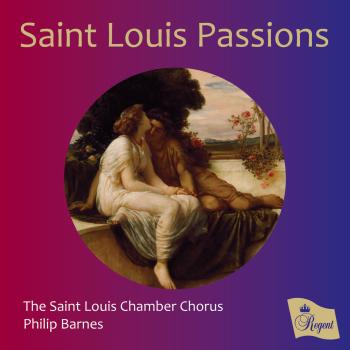
Biography The Saint Louis Chamber Chorus & Philip Barnes
The Saint Louis Chamber Chorus
is a not-for-profit organization committed to presenting the finest a cappella choral works, seeking to entertain, educate, and inspire audiences through its unique programs in St. Louis’s finest public buildings. Now enjoying its seventieth season, the ensemble performs six concerts annually and may be heard on numerous compact discs and downloads from the Regent label. Under the direction of English conductor Philip Barnes, the Chamber Chorus combines outstanding acoustics with originality and excellence of its presentations, and has established an enviable reputation as the Midwest’s premier a cappella ensemble.
Major American cities can routinely offer several choirs of excellence, but what distinguishes St. Louis is a chamber choir with an enviable history of championing both neglected and newly written repertoire in countless outstanding performances. The stability afforded the choir by having only four artistic directors over 70 years has supported its musical growth, which in recent years has led to a commitment to unaccompanied repertoire. Each season the singers present six programs that include both canonical works of choral music, as well as the less familiar and several world premières. That both the founder, Ronald Arnatt, and current Artistic Director, Philip Barnes, were raised in the English cathedral tradition accounts for the preponderance of British music in the choir’s repertoire. However, much care and attention are lavished on other traditions, notably polychoral works from the Renaissance, the German Romantics, and American classics. Since Barnes’s appointment in 1989, there has been a gradual shift toward the commissioning of new music, and this has yielded important works from some of the most significant contemporary writers of choral music. More than any other ensemble in the region, the Chamber Chorus is intentional in its advocacy for women composers, whose work may be heard at every concert.
The Chamber Chorus is affiliated with the American Choral Directors Association. The Chorus is not associated with any religious or educational institution, and welcomes performers and listeners from any background, discriminating against no one. Although much of the Chorus’ repertoire is sacred and sung in sacred buildings, the repertoire and venues are selected purely on artistic grounds.
The repertoire of the Chorus ranges from the Renaissance to the present day. The diverse nature of the Chorus’ repertoire is yet more daunting for its linguistic range, with as many as ten languages sometimes appearing in a single season’s repertoire.
Although the Chorus is perhaps a little too large to perform Renaissance madrigals written on an intimate scale, there is nonetheless much other Renaissance repertoire which benefits from a ‘choir’ (rather than a ‘consort’) performance. Among the more recognized composers from this period regularly represented in the Chorus’ programs are Gibbons, Handl and Palestrina.
The Chorus’ programs explore the choral writing of acknowledged masters such as Brahms and Holst whose instrumental music may already be familiar; this provides a different perspective on composers who tend to be better known for their orchestral works. In this respect the Chamber Chorus acts as a ‘classical ensemble,’ complementing other organizations such as the St. Louis Symphony and Philharmonic Orchestras.
As befits a mixed voice choir, particular attention is paid to the literature of the nineteenth century, a period when choral singing enjoyed a great revival and highly proficient choruses developed in many European and American cities. In response to this new constituency, composers wrote challenging and extended works, and indeed such masters as Brahms, Mendelssohn, Schubert and Schumann found remuneration in writing for, and training, these ensembles. In most seasons, then, the Chorus performs lieder or motets by these composers and their contemporaries.
The renaissance of choral music in Britain during the past hundred years provides another focus for the choir (not a surprise, given the background of the founding and current artistic directors). To this end, the Chamber Chorus has performed many works by Holst, Howells and Vaughan Williams, and by some St. Louis premières of works by contemporary British composers, such as Judith Bingham and David Matthews. Modern American composers are also well represented, with several world or regional premières by Howard Helvey, Stephen Paulus and Ned Rorem, to name but a few.
Some composers excelled in writing for the voice, and their works constitute a central portion of the Chamber Chorus’ repertoire. Through the Chorus’ performances you can appreciate the creativity of a wide chronological and geographical span from Adrian Willaert to Herbert Howells. Many of these works are not widely recorded, if at all, and so our concerts represent a unique opportunity to hear them performed in St. Louis. Every generation may claim its share of the unjustly forgotten, and most Chamber Chorus concerts include hitherto unknown ‘gems,’ sometimes by indifferent composers rising, albeit briefly, to write a beautiful miniature.
The development of the choir’s repertoire and its high standard of performance have been corroborated in a series of commercial CDs. Following several privately recorded discs, the Chamber Chorus released a disc of ancient poetry settings through Bolchazy-Carducci (Chicago). This was followed by a selection of Spanish music for Guild Records (Switzerland), and most recently seven discs for the British label, Regent Records. These recordings have garnered praise and coverage in a wide range of publications, from Gramophone magazine to Choral Journal, to The Guardian, a national daily newspaper in the UK.
Such recordings are currently the only way to enjoy the Chamber Chorus if attending one of the season’s six performances is not a possibility. The choir does not tour or perform at conventions; its primary focus is to present a series of subscription concerts in the greater St. Louis area. Programs are tailored to, and often inspired by, the physical setting of the performance, and given the city’s extraordinary wealth of architecture and traditions, this may include Hungarian motets, Hebrew laments, and ancient Greek choruses, and all within the space of four or five months. Performances are not repeated, and repertoire is rarely repeated within a ten year cycle, all of which encourages choral music lovers to make the choir’s concert dates a priority.
Philip Barnes
grew up in the Northwest of England, and he was educated at the Manchester Grammar School and the University of Manchester (music); he also studied at Bristol University (classics) and King's College in London (education). In London he sang with numerous church choirs, notably St. Margaret's - Westminster Abbey, the Consort of St. Martin's-in-the-fields, and the Chapel Choir of the Tower of London, and he was a frequent deputy at St. Paul's Cathedral. He also worked with many secular ensembles in London's leading concert halls, and recorded for several major classical labels, including Hyperion, London-Decca, Conifer, and may be heard on Mannheim Steamroller's A Fresh Aire Christmas (American 'Gramaphone') with John Rutter's Cambridge Singers. As a choir director, he founded the Hereford Chamber Choir, and shared in leading a six-voice ensemble, Variation, which undertook numerous concert tours and made recordings in France.
In 1988 he left London for St. Louis to chair the Classics Department at John Burroughs School. A decade later he was awarded the first Johnston Endowed Chair in Classics. In addition to his teaching, he also served as Burroughs's curriculum coordinator. Though he has since yielded the Chair and the coordinator positions, he remains the director of the school's annual programs in Italy and Greece and continues to teach Greek and Latin at the school.
Soon after his arrival in St. Louis, he was appointed assistant choirmaster at Christ Church Cathedral, and also sang in the choir at Temple Shaare Emeth. Since then he has also sung with the choirs of St. Peter's in Ladue and several other churches, and for three years served as choirmaster of Holy Communion Church in University City. Since 2016 he has served as Director of Music at Third Baptist Church, located in St. Louis’s Grand Center.
In 1989 Philip Barnes was invited to direct the St. Louis Chamber Chorus, becoming only the fourth artistic director since its foundation in 1956. His tenure with the Chamber Chorus has been marked by continual growth, both artistically and in terms of organization. The group has established itself as the leading chamber choir of the region, and it has received numerous plaudits from the press and media. Philip Barnes has created a distinctive sound for the choir that is both rich and arresting. The Chorus has embraced the literature written for unaccompanied choir, and it has ensured that St. Louis audiences may enjoy in live performance masterpieces of the repertoire, from the Renaissance to the Romantic period, and thence to the present day. Philip has led the choir in the performance of more than 1400 works, some of which individually contain many movements; see the repertoire section of this web site for listings of all of these works. No other choir in the Midwest, and few anywhere beyond our region, can boast such a broad repertoire of music from many periods and lands, performed in the original language and to the highest musical standards.
In addition to his remarkable knowledge of the existing choral repertoire, Philip Barnes has forged a reputation for championing new additions to the literature. In addition to his numerous first American performances, he has also presented many world premières, many of which were written for him and the Chamber Chorus. He has worked closely with many prominent choral composers around the world, including Ronald Arnatt, Richard Rodney Bennett, Melissa Dunphy, Sydney Guillaume, Howard Helvey, Stephen Paulus, Ned Rorem, and Steven Stucky in the United States; David Bednall, Judith Bingham, Kerensa Briggs, Bob Chilcott, Jonathan Dove, Gabriel Jackson, Sasha Johnson Manning, David Matthews, Jonathan Pitkin, Francis Pott, Robert Walker, Magnus Williamson and Patrick Zuk in Great Britain; Clare Maclean in Australia; Eriks Esenvalds and Ugis Praulins in Latvia; Carl Rütti in Switzerland; Mårten Jansson in Sweden; Yakov Gubanov in Italy. Collaborations with the acclaimed musicologist Dr. Craig Monson have also seen the first performance in modern times of motets by Gabriele Fattorini and John Sheppard. For several composers, notably Kerensa Briggs, Melissa Dunphy, Ned Rorem, and Sasha Johnson Manning, Philip has provided either a translation from Greek or an original verse in English.
Under his direction the Chorus has made sixteen compact discs. Six of them were produced locally, one in collaboration with a Chicago-based publisher, and one with the Swiss-based label, Guild. Most recently, he has recorded eight times for Regent Records in Great Britain, first releasing a disc of works commissioned for the Chorus, and then an anthology of compositions by Granville Bantock, released in late 2009. In 2011 Regent issued Christmas in Saint Louis, a program Mr. Barnes directed of traditional American carols contrasting with recent commissions written specially for the Chamber Chorus. Two years later, a new anthology of American masterworks became available from Regent, and this was followed by Saint Louis Firsts, Saint Louis Classics and Saint Louis Premieres. The latest album, released in the summer of 2024, was Saint Louis Reflections (See our Recordings page.)
Philip Barnes has also worked with a touring vocal ensemble, Musica Missouri, which he co-founded to present the works of choral composers with Missouri associations. This group's first tour was to Italy in 1998, where he directed concerts to packed audiences in Rome and the Naples area. Another European tour was arranged in the summer of 2004, which saw Philip conducting concerts in major cities in Portugal and Extremadura (Spain). Later, the ensemble returned to the Iberian Peninsula for more programs in Portugal, and then across the Spanish border, Galicia. In 2012, Musica Missouri toured East Anglia (Great Britain), collaborating with local choirs and appearing in several concert series, including the Wymondham Festival.
Philip Barnes has lectured widely, and he has directed choral workshops in Missouri and beyond. In January 2019 he flew to Moscow to address the Orthodox Patriarch’s Christmas Readings conference. He maintains a dual career of musician and classicist, and he has given numerous papers on the application of music in modern productions of ancient Greek drama, and also analyses of modern settings of Roman verse. For many summers he has taught at New York State's Chautauqua Institution, leading classes on both music and classical languages. Since 2006 he has reviewed recordings for the The Choral Journal, the monthly magazine of the American Choral Directors Association, and articles by him have been published in the British magazine, Choir & Organ.
Like Dr. Arnatt, the Chorus's founder, Philip Barnes has been recognized with an award from the American Guild of Organists for his outstanding contribution to choral music in St. Louis. In her year-end summary of 2006, Sarah Bryan Miller of the St. Louis Post-Dispatch dubbed Philip Barnes "Conductor of the Year" in recognition of his achievements with the Chamber Chorus. He has continued to garner similar recognition in ensuing years. In 2019 he received an honorary doctorate by the Aquinas Institute at St. Louis University for his contributions to the artistic life of St. Louis. In 2022, he was awarded a Bogliasco Fellowship, which provided the opportunity to complete his translation of all the choruses (‘odes’) in the Antigone by Sophocles. These have been made specifically for composers to set to music for the Chamber Chorus.
In his fourth decade with the choir, Philip Barnes this season conducts new works by Kerensa Briggs, Carter Datz, and Melissa Dunphy, and he gives the American première of a trilogy by Alexander L’Estrange. Philip continues to present papers at various classical meetings, teach in St. Louis, and give lectures at Chautauqua. and so far, versions have been made by Kerensa Briggs, Sasha Johnson Manning, and Ned Rorem.