


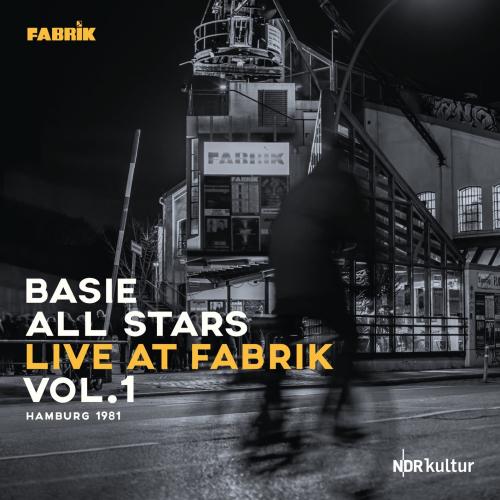
Live at Fabrik Hamburg 1981, Vol. 1 (Live) Count Basie
Album info
Album-Release:
2022
HRA-Release:
24.03.2023
Album including Album cover
- 1 Bluesbird Blues (Live) 09:33
- 2 Please Send Me Someone To Love (Live) 06:02
- 3 Shiny Stockings (Live) 09:09
- 4 Everything Happens To Me (Live) 06:25
- 5 This Is All I Ask (Live) 06:37
- 6 I'm Confessin' That I Love You (Live) 08:32
- 7 Little Pony (Live) 12:20
Info for Live at Fabrik Hamburg 1981, Vol. 1 (Live)
Sixth release of the "Live At Fabrik Hamburg" series on Jazzline in cooperation with the legendary venue and NDR Kultur - the first and instrumental part of the performance of the nine-member line-up from 05 May 1981.
Jazz icon Count Basie is not only considered one of the most influential bandleaders of all time, he also had a decisive influence on all popular music as a pianist, organist and composer. The founder and "King" of big band swing made numerous other world stars famous. Even during his lifetime, the Count Basie Allstars were formed with musicians who, in some cases, helped shape the history of swing big bands for decades.
The 1981 concert recording from the Hamburg Fabrik was made with trumpeters Harry "Sweets" Edison and Joe Newmann, trombonist Benny Powell, alto saxophonist Marshall Royal, tenor saxophonists Buddy Tate and Billy Mitchell, pianist Nat Pierce, bassist John Heard and drummer Gus Johnson.
The repertoire is based on Count Basie's compositions and the release is divided into two parts: this first part deals with the instrumental pieces of the concert, while the yet to be released second part features the voluminous blues and swing voice of Joe Williams.
Harry ‘Sweets’ Edison, trumpet
Joe Newman, trumpet
Benny Powell, trombone
Marshall Royal, alto saxophone
Buddy Tate, tenor saxophone
Billy Mitchell, tenor saxophone
Nat Pierce, piano
John Heard, bass
Gus Johnson, drums
Digitally remastered
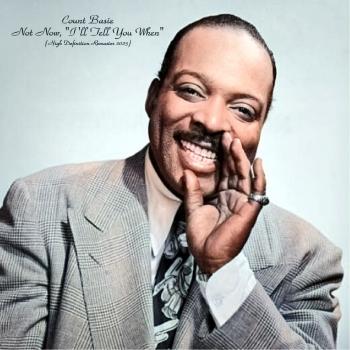
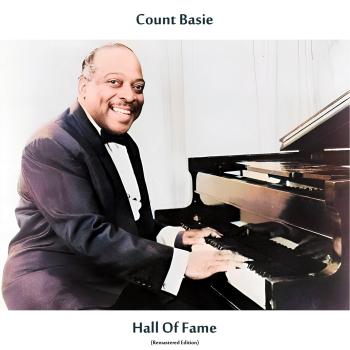
Count Basie
He played for kings and queens and presidents, but at the piano or leading his groundbreaking orchestra, William “Count” Basie was the embodiment of entertainment royalty.
Growing up in Red Bank, Basie learned the value of hard work. His father was a coachman, groundskeeper, and handyman for wealthy families in the area. His mother was a laundress. Lillian Basie also played piano and gave her son his first lessons on the keyboard.
Although a good student, Basie dropped out of junior high school to pursue a career in entertainment. He did chores at the local Palace Theater and quickly learned how to operate the lights for vaudeville shows. In no time, he was improvising piano accompaniment for silent films. Playing both piano and drums, Basie performed at dances and amateur shows, landing gigs in Asbury Park and other Jersey Shore towns.
Around 1920, Basie, still in his teens, moved to Harlem to seek opportunities and connect with the more-accomplished New York musicians. Basie made connections and soon was touring as an accompanist as far west as Kansas City and New Orleans. Returning to Harlem, he met the legendary keyboardist Fats Waller, who gave Basie informal lessons on the organ.
Later in the 1920s, Basie found himself stranded in Kansas City. He remained–and joined a band led by fellow pianist Bennie Moten. Together, they pioneered an upbeat style of jazz called Kansas City Stomp. Eventually, Basie started his own nine-piece band, the Barons of Rhythm, with future jazz icon Lester Young on tenor saxophone. One night, during a live radio performance with the band, the announcer gave Basie the name “Count,” to put his music in a class with Duke Ellington.
Another of those radio performances resulted in the band’s discovery by the influential talent scout John Hammond, who produced Basie’s earliest recordings. Basie next moved his band to New York, bringing their lively “jump” sound to such popular venues as the Roseland Ballroom and the Savoy. At various times, the band featured such fabulous vocalists as Billie Holiday, Jimmy Rushing, and Helen Humes. Basie himself wowed audiences with his spare, blues-oriented playing.
By the 1940s, Basie’s band—now the Count Basie Orchestra—was firmly established as one of the most successful attractions of the Swing Era. They played major engagements across the country, appeared in numerous movies, and scored nationwide hits with such Basie-penned swing classics as “Jumpin’ at the Woodside” and his signature tune, “One O’Clock Jump.”
The swing-era faded after World War II, but by then Basie was firmly in the entertainment elite. In the ensuing decades, he continued to tour around the world; made frequent television appearances; performed at one of President John F. Kennedy’s inaugural balls in 1961; and cut memorable recordings with the likes of Ella Fitzgerald, Duke Ellington, Oscar Peterson, and fellow future New Jersey Hall of Famers Sarah Vaughan and Frank Sinatra.
Truly a member of entertainment’s pantheon, Basie was the recipient of nine Grammy Awards; a Grammy Lifetime Achievement Award; a Kennedy Center Honors award; an NEA Jazz Masters Award; and posthumously, the Presidential Medal of Freedom. New Jersey commemorates Basie with the Count Basie Performing Arts Center in his native Red Bank.
This album contains no booklet.