

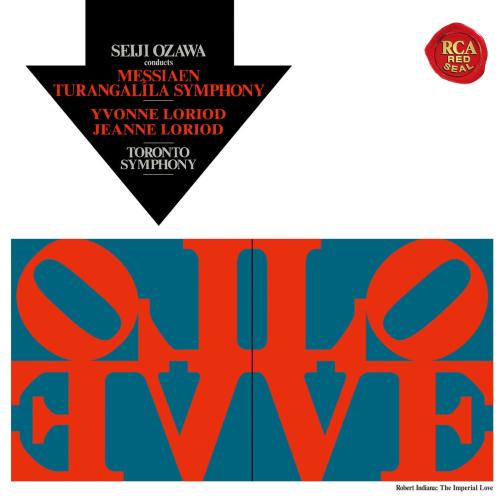
Messiaen: Turangalila Symphonie (2025 Remastered) Toronto Symphony Orchestra & Seiji Ozawa
Album Info
Album Veröffentlichung:
1968
HRA-Veröffentlichung:
05.12.2025
Label: Sony Classical
Genre: Classical
Subgenre: Orchestral
Interpret: Toronto Symphony Orchestra & Seiji Ozawa
Komponist: Olivier Messiaen (1908-1992)
Das Album enthält Albumcover
Entschuldigen Sie bitte!
Sehr geehrter HIGHRESAUDIO Besucher,
leider kann das Album zurzeit aufgrund von Länder- und Lizenzbeschränkungen nicht gekauft werden oder uns liegt der offizielle Veröffentlichungstermin für Ihr Land noch nicht vor. Wir aktualisieren unsere Veröffentlichungstermine ein- bis zweimal die Woche. Bitte schauen Sie ab und zu mal wieder rein.
Wir empfehlen Ihnen das Album auf Ihre Merkliste zu setzen.
Wir bedanken uns für Ihr Verständnis und Ihre Geduld.
Ihr, HIGHRESAUDIO
- Olivier Messiaen (1908 - 1992): Turangalîla Symphonie:
- 1 Messiaen: Turangalîla Symphonie: I. Introduction (2025 Remastered Version) 06:26
- 2 Messiaen: Turangalîla Symphonie: II. Chant d'amour 1 (2025 Remastered Version) 08:18
- 3 Messiaen: Turangalîla Symphonie: III. Turangalîla 1 (2025 Remastered Version) 05:14
- 4 Messiaen: Turangalîla Symphonie: IV. Chant d'amour 2 (2025 Remastered Version) 11:19
- 5 Messiaen: Turangalîla Symphonie: V. Joie du sang des étoiles (2025 Remastered Version) 06:26
- 6 Messiaen: Turangalîla Symphonie: VI. Jardin du sommeil d'amour (2025 Remastered Version) 11:54
- 7 Messiaen: Turangalîla Symphonie: VII. Turangalîla 2 (2025 Remastered Version) 04:02
- 8 Messiaen: Turangalîla Symphonie: VIII. Développement de l'amour (2025 Remastered Version) 11:33
- 9 Messiaen: Turangalîla Symphonie: IX. Turangalîla 3 (2025 Remastered Version) 04:36
- 10 Messiaen: Turangalîla Symphonie: X. Finale (2025 Remastered Version) 07:05
Info zu Messiaen: Turangalila Symphonie (2025 Remastered)
Olivier Messiaen’s Turangalîla-Symphonie, a gigantic 10-movement extravaganza for symphony orchestra, piano, and that strange early electronic instrument, the ondes Martenot, is the most approachable of his works — and in some ways out of character. Here, one of the most devoutly religious major composers of the 20th century makes all kinds of hedonistic, even orgiastic sounds in the name of universal love. He didn’t like jazz, yet some of the splashier harmonies and syncopations in this piece all but suggest its influence.
Leonard Bernstein gave the world premiere in Boston and repeated it in New York in 1949 but never performed it again nor recorded it. (It so happens that certain repeated passages seem to echo a tune in his own ballet Fancy Free, which debuted five years earlier.) Knowing Bernstein’s temperament, that would have been a thriller of a recording. Messiaen’s student Pierre Boulez, otherwise a champion of his teacher, hated the piece, reportedly calling it “brothel music.”
Turangalîla was entirely absent from American record catalogs until December 1967, when the young Seiji Ozawa recorded it with the Toronto Symphony at Messiaen’s suggestion, a smashing, wild, and wooly performance in which the TSO played beyond itself. It was a benchmark in its time, mainly because it was the only recording available in the U.S. for at least the next decade. Yet even after the dam broke and a moderate-sized flood of recordings came out, Ozawa’s still holds its own on RCA’s vividly remastered CD. You can sense the thrill of discovery amid the all-you-need-is-love vibes of the 1960s, which Turangalîla presciently captured in 1949.
Now, 57 years after its first Turangalîla, the TSO has done the piece again for Harmonia Mundi, its first recording under Music Director Gustavo Gimeno. The album came out only four days before Ozawa’s death, on Feb. 6 at the age of 88, which makes this release something of a memorial tribute as well as a state-of-the-orchestra report on what a difference more than half a century has made.
While the Ozawa disc featured Yvonne Loriod (Messiaen’s second wife) on piano and her sister Jeanne on ondes Martenot — up until that time, they were practically the only ones who were performing the piece — Gimeno has the no less formidable Canadian pianist Marc-André Hamelin and ondes Martenot specialist Nathalie Forget. Hamelin is capable of playing just about anything at a top level, and so he does here with this difficult music, rendering it crisply and with panache. Forget’s spooky, swooping work, however, is often buried in the mix.
The TSO sounds like a more accomplished orchestra now, in accordance with the rising technical standards of most orchestras since 1967. Yet the first movement gives away the story of much of the performance — straight-ahead, mostly fast, even routine-sounding in stretches. The most spectacularly brassy (and somewhat kooky) movement of all, “Joie du sang des étoiles” (Joy of the blood of the stars), is superficially rushed on this recording; Ozawa’s take, by contrast, is messier yet far more stimulating. Oddly enough, the remastered sonics on the Ozawa disc have greater impact and breadth than those on the Gimeno production, which sounds a bit distant and washed-out by comparison.
Toronto Symphony Orchestra
Seiji Ozawa, conductor
Digitally remastered
Toronto Symphony Orchestra
Seit über einem Jahrhundert trägt das Toronto Symphony Orchestra (TSO) dazu bei, die kanadische Kultur zu pflegen und zu feiern. Zu der großen Geschichte des Orchesters gehören zahlreiche erfolgreiche Konzerte und Aufnahmen, Tourneen in Kanada und dem Rest der Welt sowie viele produktive Partnerschaften; zudem engagiert es sich in regionalen und nationalen Gemeinschaften, deren Alltag es mit spannenden musikalischen Ereignissen bereichert. Sein Chefdirigent Gustavo Gimeno prägt mit weitläufigen künstlerischen Visionen, intellektueller Neugier und seiner Lust auf Abenteuer die Programmgestaltung dieses aus 93 Mitgliedern bestehenden Klangkörpers, der im Dienst von Toronto steht – einer der facettenreichsten Städte der Welt.
Als eine Gruppe von Musikern, Lehrern und Mitstreitern, die alle davon überzeugt sind, dass die Musik die Fähigkeit hat zu heilen, zu inspirieren und Menschen aller sozialen Schichten zu verbinden, wendet sich das TSO an ein junges und weniger junges Publikum mit vielen Angeboten im Bereich Erziehung, gesellschaftliche Integration und Gesundheit sowie Veranstaltungen, die dem Wohlbefinden dienen. In der Spielzeit 2023/24 feiert man das 50-jährige Bestehen des Toronto Symphony Youth Orchestra (TSYO), das dem TSO angeschlossen ist und für die im Werden begriffene Musikergeneration von Kanada eine kostenlose praktische Ausbildung anbietet. Das TSO organisiert in seiner langjährigen Spielstätte, der Roy Thomson Hall, auch Tage der offenen Tür und Gratiskonzerte. Die Relaxed Performances sind Veranstaltungen für neurodivergente Menschen, z.B. Autisten und Personen mit sensorischen und kommunikativen Störungen oder Aufmerksamkeitsdefiziten mit und ohne Hyperaktivität (TDAH) oder Demenzkranke. Art of Healing unterstützt in Zusammenarbeit mit dem Zentrum für Drogenabhängigkeit und seelische Gesundheit Patienten, die den indigenen Völkern Kanadas sowie den Inuit und Métis angehören, mit musikalischen Geschichten und Kompositionen. TSOUND Connections nutzt Musik und Technologie, um die Mitglieder des TSO mit älteren, pflegebedürftigen Menschen zusammenzubringen, um diese aus der sozialen Isolation zu holen und für ihr Wohl zu sorgen. Das Programm Morning with the Toronto Symphony Orchestra bietet Musikstudenten aus dem Großraum Toronto offene Proben an. Und schließlich treten die Mitglieder des Orchesters im Rahmen des Projekts Symphony Storytime und in Partnerschaft mit der öffentlichen Bibliothek von Toronto live auf und lesen dabei auch Kindergeschichten vor, um Familien und Kindern den Zugang zum Lesen und Schreiben und zur musikalischen Bildung zu erleichtern.
Seit der ersten Plattenaufnahme im Jahr 1952 bilden die Einspielungen einen wichtigen Bestandteil des künstlerischen Vermächtnisses des TSO. Von den über 150 Titeln seiner Diskografie wurden viele mit bedeutenden Preisen ausgezeichnet, in jüngster Zeit z.B. die Aufnahmen mit Werken von Vaughan Williams unter der Leitung des TSO Conductor Emeritus Peter Oundjian (2019) bzw. von Massenets Thaïs unter der Leitung des TSO Conductor Laureate Sir Andrew Davis (2021). Diese beiden Einspielungen erschienen beim Label Chandos und gewannen den JUNO-Preis, die zweitgenannte wurde auch für die GRAMMY® Awards nominiert. Die vorliegende Aufnahme ist die erste Zusammenarbeit des Orchesters mit harmonia mundi, und es handelt sich um seine zweite Aufnahme der Turangalîla-Symphonie. Die erste wurde 1968 bei RCA und unter der Leitung des damaligen Chefdirigenten Seiji Ozawa gemacht; auch diese Einspielung erhielt eine GRAMMY®-Nominierung und wird bis heute allgemein als eine Referenzinterpretation dieses Meisterwerks von Messiaen betrachtet.
Seiji Ozawa
For more than half a century, Seiji Ozawa was an icon for concert and opera audiences in Europe, North America, and Japan, as well as a steadfast advocate for young musicians. Born in 1935 in Mukden, Manchuria (now Shenyang, China), he graduated in both composition and conducting from Tokyo’s Toho School of Music. In 1959, he won first prize at the International Competition of Orchestra Conductors in Besançon, France, where he came to the attention of Boston Symphony Music Director Charles Munch, who invited him to Tanglewood, where he won the Koussevitzky Prize as the outstanding student conductor in 1960. While working with Herbert von Karajan in Berlin, Ozawa came to the attention of Leonard Bernstein, who appointed him assistant conductor of the New York Philharmonic for the 1961–62 season. He made his first professional concert appearance in North America in 1962 with the San Francisco Symphony.
Ozawa’s series of major appointments began with the music directorship of the Ravinia Festival, followed by the role of Music Director of the Toronto Symphony Orchestra and of the San Francisco Symphony. He first conducted the Boston Symphony Orchestra at Tanglewood and was subsequently named Tanglewood Artistic Director in 1970 and Boston Symphony Music Director in 1973, holding that post for 29 seasons – the longest-serving music director in the orchestra’s history. He left a legacy of brilliant achievement evidenced through touring, award-winning recordings (more than 140 works of more than 50 composers on 10 labels), television productions (winning 2 Emmy awards) and commissioned works. 1994 saw the inauguration of the Seiji Ozawa Hall at Tanglewood.
In Japan, Ozawa formed the Saito Kinen Orchestra with Kazuyoshi Akiyama in 1984 to commemorate their late mentor, Hideo Saito. The orchestra held hugely successful concerts in Tokyo and Osaka and went on to tour Europe in 1987, 1989 and 1990. In 1991, it performed concerts in Europe and America and was received to great acclaim. These activities led to the inception of Ozawa’s artistic dream in 1992: the Saito Kinen Festival Matsumoto. Ozawa became director of this international music festival, a role that continued until his death in 2024. From 2015, the festival was renamed the Seiji Ozawa Matsumoto Festival. Ozawa also founded an academy for aspiring orchestral players and in Switzerland, he founded an international music academy dedicated to training young musicians in chamber music. From 2002 to 2010, Ozawa was Music Director of the Wiener Staatsoper, and he was for many years a favourite guest of the Wiener Philharmoniker. He also maintained close ties to the Berliner Philharmoniker and the Orchestre National de France.
Ozawa’s discography for the Universal labels is immense and, as a uniquely sympathetic partner, he made many acclaimed recordings with such artists as Renée Fleming, Gidon Kremer, Viktoria Mullova, Anne-Sophie Mutter, Itzhak Perlman, Mstislav Rostropovich, and Krystian Zimerman.
Ozawa won many awards in Japan and abroad, including: the Asahi Prize (1985); an Honorary Doctorate from Harvard University (2000); the Austrian Cross of Honour for Science and Art, First Class (2002); the Mainichi Art Award (2003); the Suntory Music Prize (2003); an Honorary Doctorate from the Sorbonne University of France (2004); Honorary Membership from the Wiener Staatsoper (2007); France’s Officier de la Légion d’Honneur (2008); Foreign Associated Member in the Académie des Beaux-Arts de l’Institut de France (2008); the Order of Culture, which is the highest honor in Japan (2008); Giglio D’Oro by Premio Galileo 2000 Foundation of Italy (2008); the first Japanese national to be bestowed honorary membership to the Vienna Philharmonic (2010); the Praemium Imperiale from the Japan Art Association (2011); the Akeo Watanabe Foundation Music Award (2011); and the Kennedy Center Honors (2015). In February 2016, the Ravel L’enfant et les sortilèges album conducted by Seiji Ozawa and performed by the Saito Kinen Orchestra that was recorded at the 2013 Saito Kinen Festival Matsumoto won the 58th Grammy Award for Best Opera Recording. In April 2016, he was named an Honorary Member of the Berliner Philharmoniker.
“The warmth, generosity and sense of humour that Seiji Ozawa radiated in personal encounters and conversations are among the most memorable experiences for anyone who had the pleasure to meet him, and he inspired so many young talents with his aura, advice and selfless support. He will be very much missed.”
Dieses Album enthält kein Booklet