






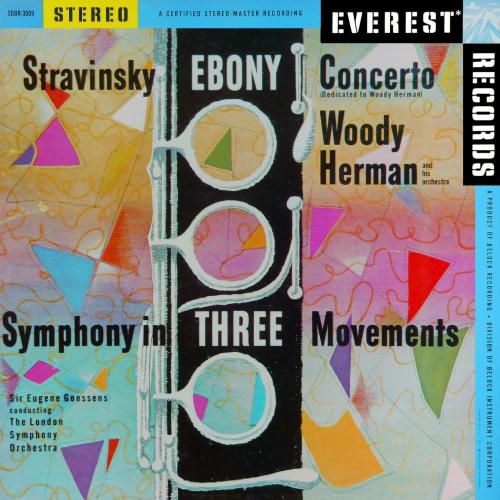
Stravinsky: Ebony Concerto & Symphony in 3 Movements (Transferred from the Original Everest Records Master Tapes) Woody Herman And His Orchestra, London Symphony Orchestra & Sir Eugene Goossens
Album Info
Album Veröffentlichung:
2013
HRA-Veröffentlichung:
15.01.2026
Label: Everest
Genre: Classical
Subgenre: Concertos
Interpret: Woody Herman And His Orchestra, London Symphony Orchestra & Sir Eugene Goossens
Komponist: Igor Stravinsky (1882-1971)
Das Album enthält Albumcover Booklet (PDF)
Entschuldigen Sie bitte!
Sehr geehrter HIGHRESAUDIO Besucher,
leider kann das Album zurzeit aufgrund von Länder- und Lizenzbeschränkungen nicht gekauft werden oder uns liegt der offizielle Veröffentlichungstermin für Ihr Land noch nicht vor. Wir aktualisieren unsere Veröffentlichungstermine ein- bis zweimal die Woche. Bitte schauen Sie ab und zu mal wieder rein.
Wir empfehlen Ihnen das Album auf Ihre Merkliste zu setzen.
Wir bedanken uns für Ihr Verständnis und Ihre Geduld.
Ihr, HIGHRESAUDIO
- Igor Stravinsky (1882 - 1971): Ebony Concerto:
- 1 Stravinsky: Ebony Concerto: I. Moderato (Remastered 2007) 03:28
- 2 Stravinsky: Ebony Concerto: II. Andante (Remastered 2007) 02:07
- 3 Stravinsky: Ebony Concerto: III. Moderato (Remastered 2007) 03:37
- Symphony in 3 Movements:
- 4 Stravinsky: Symphony in 3 Movements: I. Overture. Allegro (Remastered 2007) 10:23
- 5 Stravinsky: Symphony in 3 Movements: II. Andante (Remastered 2007) 06:23
- 6 Stravinsky: Symphony in 3 Movements: III. Con moto (Remastered 2007) 06:39
Info zu Stravinsky: Ebony Concerto & Symphony in 3 Movements (Transferred from the Original Everest Records Master Tapes)
Those who find themselves out of sympathy with the more hieratic aspects of Igor Stravinsky’s „neoclassic“ post-Sacre style, or who are baffled by the explorations of serial technique displayed in the works written after 1950 will find the Symphony in Three Movements something of a „haven of refuge.“ For there are a number of works in Stravinsky’s output which represent a genuine creative synthesis of certain styles and techniques that he would seem to have been pursuing virtually as ends in themselves. The Symphony in Three Movements, like the Symphony of Psalms, can be said to represent one of these „way stations,“ wherein the perceptive listener can establish a frame of reference in relation to the familiar work of the youthful Stravinsky (in particular Le Sacre du Printemps) and that of the „middle period“ Stravinsky of the 1930’s and 1940’s. It is even possible to „read into“ the chromatic elements exhibited in the Symphony in Three Movements the first hints of the road that would lead the composer to explore the seemingly (for him) alien world of 12-tone and serial music. The fugato subject in the finale provides an instance in point.
The most immediately striking aspect of the Symphony in Three Movements on first hearing is the wealth of coloristic and harmonic dynamism found in the first and last movements, together with the patterns of rhythmic tension we have so long regarded as Stravinsky trademarks. There is no stage or programmatic text implied in this score. Yet it is „gesture music“ par excellence. Having witnessed what dance treatment has done for the so-called „absolute“ music of the Basle Concerto for strings via Jerome Robbins‘ The Cage, it is fascinating to speculate on the balletic possibilities for this Symphony in Three Movements. Be that as it may, this is music with considerable aural excitement and no little intellectual fascination.
It was written for the New York Philharmonic Symphony Orchestra, and it was with that ensemble in Carnegie Hall that Stravinsky conducted the world premiere on January 24, 1936. Stravinsky’s orchestra might be described as the „enlarged classical“ type, with the enlargements mostly in the percussion and plectral department – bass drum, piano, harp. The latter two instruments play prominent and interesting roles throughout.
Stravinsky’s Ebony Concerto, composed for Woody Herman’s Band, would seem in some respects to be a chip from the floor of the workshop that produced the Symphony in Three Movements. Yet, in its brief span – also three movements – it has quite a special identity of its own. Scoring is for 6 saxes, 5 trumpets, 3 trombones, guitar, harp, piano, bass, and percussion. The first performance by Woody Herman’s Band was at a New York Carnegie Hall Concert on March 25, 1946. The three movements are Moderato, Andante, Moderato. The Spring 1946 issue of Modern Music offers a delightful summation of Ebony Concerto by Donald Fuller: „The piece is of course expertly contrived for the group; the sonority is delicate yet full and varied. Stravinsky has succeeded amazingly in combining jazz elements with the lighter side of his late neo-classical manner. The gay but restrained first movement wavers insidiously between styles, seems often about to become out-and-out jazz yet remains something completely itself. The slow movement, like a reconsidered blues, ponders its unhappiness with gentle concern. I should, however, have liked more excitement in the finale, where a bit of sound and fury would have been effective. The Concerto seems a touching yet very wide-awake rumination on what once gave Stravinsky material for a very rowdy Ragtime.“
It is interesting to observe, in conclusion, how Stravinsky in 1945 so brilliantly anticipated the „chamber concert jazz“ compositional experiments being pursued by Macero, Mingus, Guiffre and others a dozen years later!
London Symphony Orchestra
Sir Eugene Goossens, conductor
Woody Herman and His OrchestraEbony Concerto (1945)
Digitally remastered
Keine Biografie vorhanden.
Booklet für Stravinsky: Ebony Concerto & Symphony in 3 Movements (Transferred from the Original Everest Records Master Tapes)