



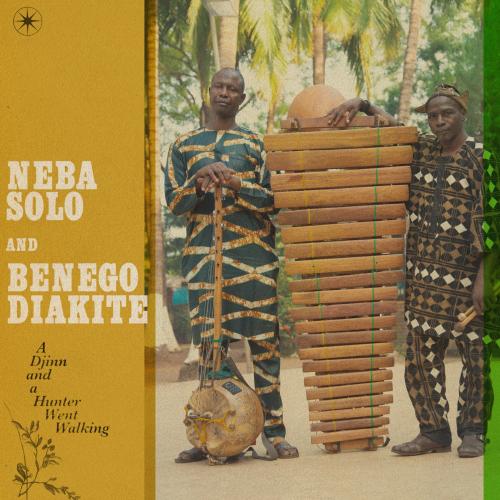
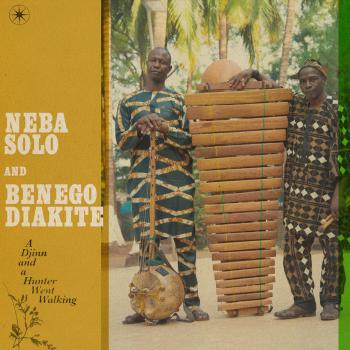
A Djinn and a Hunter Went Walking (The Complete Sessions) Neba Solo & Benego Diakité
Album Info
Album Veröffentlichung:
2026
HRA-Veröffentlichung:
13.02.2026
Label: Etoile Audio/Nonesuch
Genre: World Music
Subgenre: Worldbeat
Interpret: Neba Solo & Benego Diakité
Das Album enthält Albumcover
Entschuldigen Sie bitte!
Sehr geehrter HIGHRESAUDIO Besucher,
leider kann das Album zurzeit aufgrund von Länder- und Lizenzbeschränkungen nicht gekauft werden oder uns liegt der offizielle Veröffentlichungstermin für Ihr Land noch nicht vor. Wir aktualisieren unsere Veröffentlichungstermine ein- bis zweimal die Woche. Bitte schauen Sie ab und zu mal wieder rein.
Wir empfehlen Ihnen das Album auf Ihre Merkliste zu setzen.
Wir bedanken uns für Ihr Verständnis und Ihre Geduld.
Ihr, HIGHRESAUDIO
- 1 Djinê Mogo Tiki 05:28
- 2 Seko 04:21
- 3 Maa Kery 04:44
- 4 Yeredon Bali 05:11
- 5 Seko (interlude) 00:51
- 6 Hakilimaya 04:52
- 7 Kodonaw 04:27
- 8 Ba Ngolo 04:08
- 9 Nania Ba 04:49
- 10 Dankoro Ba 02:11
- 11 Ba Ngolo (Garden Demo) 05:21
- 12 Seko (Garden Demo) 05:06
- 13 Hakilimaya (Garden Demo) 05:21
- 14 Djinê Mogo Tiki (Garden Demo) 05:32
- 15 Maa Kery (Garden Demo) 05:00
- 16 Ba Ngolo (Balafon Solo) 05:19
Info zu A Djinn and a Hunter Went Walking (The Complete Sessions)
Legendary Malian balafon player Neba Solo and donso n’goni player Benego Diakité’s A Djinn and a Hunter Went Walking—the first in a series of new releases in collaboration with longtime Nonesuch partner Nick Gold, former head of World Circuit Records—is due February 13 on Etoile Audio / Nonesuch. On the album, co-produced by Gold, Ousmane Haïdara, and Sonny Johns, the acoustic instrumentals are complemented by vocals and percussion as well as touches of mellotron, guitar, and strings.
The Complete Sessions of A Djinn and a Hunter Went Walking comprises two albums from Neba Solo and Diakité, the leading players of their traditional Malian instruments the marimba-like balafon, or bala, and donso n’goni, a hunter’s harp. On disc one, their acoustic instrumentals are complemented by vocals and percussion as well as touches of mellotron, guitar, and strings; the second disc features their original duo performances, unadorned, recorded in a Bamako garden under a mango tree. They started after the sun went down, and crickets can be heard chirping during the quiet moments.
The musical conversation that became A Djinn and a Hunter Went Walking began more than a decade ago. Haïdara and Gold first thought of combining these two instruments from different Malian cultures while preparing to record the legendary vocalist Oumou Sangaré’s Seya for World Circuit. Despite their cultures’ geographic proximity, the instruments Neba Solo and Diakité play do not often interact: Neba Solo is from Kenedougou, where the balafon was traditionally played in the fields to inspire farmers, and Diakité is from the nearby Wassoulou region, where the culture revolves around hunting. Gold had heard a balafon player in a Bamako restaurant and immediately thought the sound of the instrument might complement Sangaré’s record.
They invited Neba Solo to the Seya sessions, where the rising bala star hit it off with the band, developing a strong musical rapport with Diakité, a donso n’goni veteran. Sensing chemistry bubbling through ad-libbed music the two played warming up, Gold and Haïdara encouraged the two to explore further, and the session that became A Djinn and a Hunter Went Walking was arranged. Neba Solo brought a balafon he had customized with an extended bass register, and Diakité brought his deepest donso n’goni.
As Ingrid Monson explains in her album liner note, which is drawn from her forthcoming Oxford University Press book The Voice of Kenedougou: Neba Solo and Senufo Sensibility in Malian Music, “Because the traditional songs they recorded were widely known in Mali, Haïdara at first planned an entirely instrumental duet album (to which Malian aficionados could hear the words in their heads). One night soon after, in the same courtyard, Haïdara played the recordings to Nick Gold on a pair of huge speakers. He was blown away. To create some variety over the course of an album, they decided to add touches of vocals and percussion. Neba Solo was inspired and made full vocal and percussion arrangements for every song. This in turn inspired an invitation to the English musician Sonny Johns, who added touches of strings, mellotron, guitar, and bass. Contributions were made in one country that inspired further additions in the other, a process which flowed easily into this unique album.”
With this release, Neba Solo and Benego Diakité, long known as “musicians’ musicians” in Mali, step into the spotlight, joining a long line of their fellow Malians who have received worldwide attention over the past several decades—including Salif Keita, Ali Farka Touré, Toumani Diabaté, Oumou Sangaré, Tinawiren, Songhoy Blues, Amadou and Mariam, Rokia Traoré, and Fatoumata Diawara—many of whom have worked with World Circuit and/or Nonesuch Records in the past.
Neba Solo, balafon (1-16), lead vocals (1-4, 6-10, 15), percussion (dundun ba, calabash) (1-4, 6-10, 12, 14-15)
Benego Diakité, donsongoni (1-15)
Souleymane Sidibe, percussion (yabara, karinyang) (1-10), lead vocals (9)
Maimouna Soumounou, additional lead vocals (1), baking vocals (7)
Bakoro Sidibe, backing vocals (1-3, 6-8, 10), lead vocals (2)
Josephine Dembele, backing vocals (1-4, 6-8, 10), duet (4)
Fanta Dogomani Coulibaly, backing vocals (1-4, 6-8, 10), lead vocals (4)
Sonny Johns, bass (1, 8-10), tanpura sample (1, 3), bass synthesizer (2, 6), mellotron (2, 6), drum machine (2, 4, 6, 9), electric guitar (3, 7), double bass (3), sampling & programming (4)
Seb Rochford, drums (1)
John Elliott, string arranger & conductor (1, 9)
Sophie Cameron, violin (1, 9)
Alison D’Souza, viola (1, 9)
Zosia Jagodzinska, cello (1, 9)
Awa Dembele, backing vocals (7)
Keine Biografie vorhanden.
Dieses Album enthält kein Booklet